The most talked-about skincare ingredient of 2026 is, depending on how you say it, either a purified fraction of DNA with a documented receptor target, or fish sperm.
Both descriptions are accurate, which is most of the reason the trend went as far as it did. Kim Kardashian discussed the treatment earlier this year; in June, the Korean brand Anua made Kendall Jenner its first global ambassador and built the entire campaign around a PDRN serum spray. The phrase "salmon sperm facial" did what no dermatology term ever could: it became genuinely funny, and therefore unstoppable.
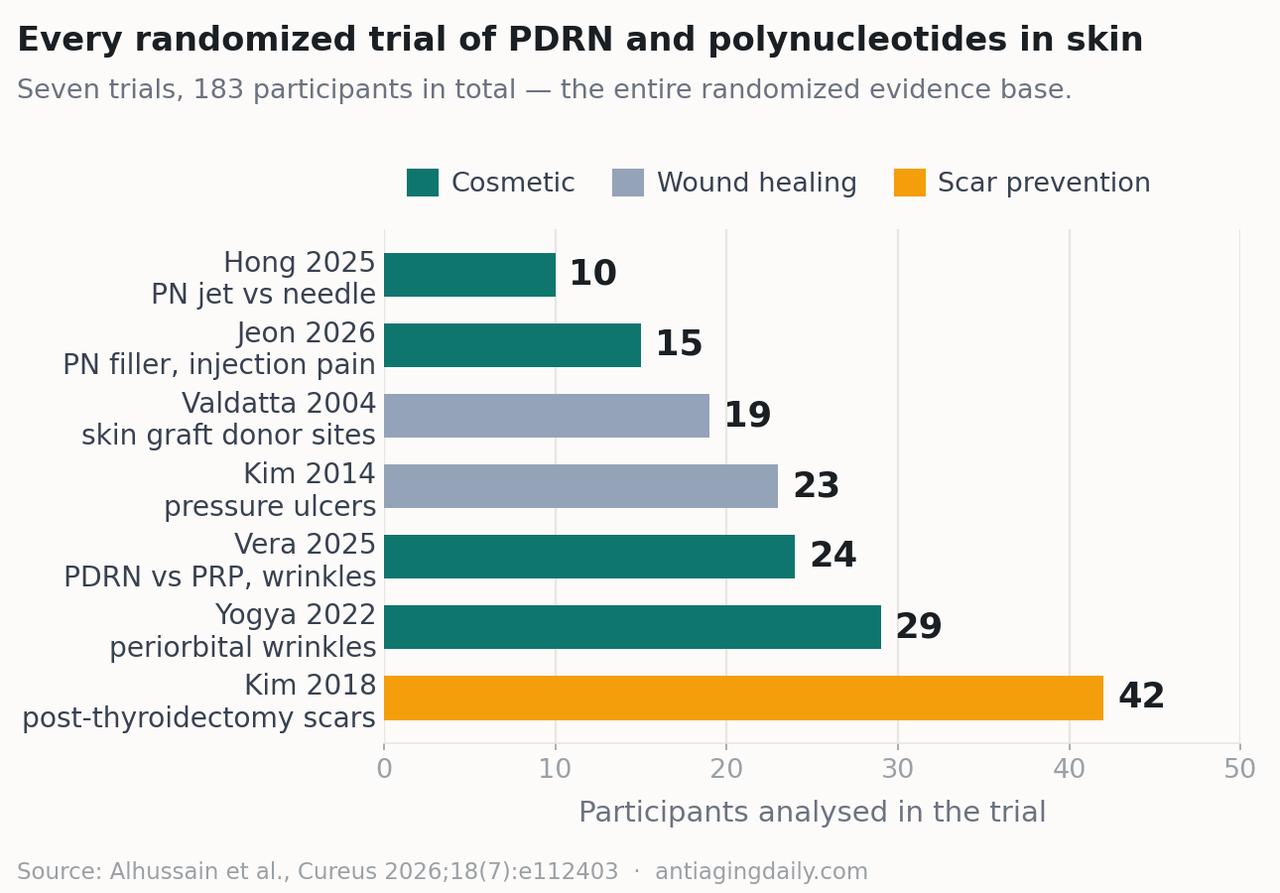
Underneath the branding sits a real molecule with a real literature. What almost nobody reporting on the trend has mentioned is how small that literature is. In July 2026, a team led by Ahmed Alhussain published the first systematic review restricted to randomized trials of these compounds in skin, searching PubMed, Embase and the Cochrane register through January 2026. The complete global haul came to seven trials and 183 participants.[1]
One hundred and eighty-three people — spread across three different medical questions, in a market now selling to millions.
What PDRN actually is
PDRN stands for polydeoxyribonucleotide: a mixture of DNA fragments extracted from salmon gonads, then purified to strip out proteins, peptides and cellular debris. That purification is the step that matters, because it also removes anything capable of provoking an immune reaction to foreign tissue. Nothing recognisably fishy survives it.
The mechanism has nothing to do with your cells reading salmon genetic code. Enzymes in the skin break the fragments down into their building blocks, one of which is adenosine (C10H13N5O4). Adenosine binds the A2A receptor on fibroblasts, raising intracellular cyclic AMP and shifting the cell toward repair: more collagen synthesis, less inflammatory signalling.[2] A second route, the salvage pathway, recycles the nucleotides directly.
So the active principle is essentially a slow-release adenosine delivery system assembled out of fish DNA. Salmon is used because it is abundant, cheap and well characterised — not because there is anything special about salmon.
The trials, and what they really found
Four of the seven randomized trials looked at cosmetic skin rejuvenation. Three of the four used a split-face design, where each half of one person's face gets a different treatment. That is a genuine strength — it controls for everything about the individual — but it cannot overcome a sample of ten.[1]
The most quoted result comes from Vera and colleagues, who randomized 24 women aged 30 to 50 to microneedling plus 3% salmon PDRN, or microneedling plus platelet-rich plasma. On the Lemperle wrinkle scale the PDRN group fell from 2.33 to 1.00 — a 57% reduction — against 2.33 to 1.50 for PRP, a significant difference between groups (p=0.021).[3] A real result in PDRN's favour. It is also twelve people per arm, followed for six weeks, in a trial the reviewers rated "some concerns" for risk of bias.
The largest cosmetic trial, by Yogya and colleagues, rewards careful reading. Twenty-nine women had radiofrequency microneedling on both sides of the face, with topical polynucleotide added on one side only. By Antera 3D imaging, wrinkle indentation improved earlier on the treated side, significantly so at two months (p=0.006). But maximum wrinkle depth showed no significant difference between sides at any point across six months.[4] Both sides improved substantially — unsurprising, since both got radiofrequency microneedling, which works on its own. The added molecule accelerated one measure and left the headline measure unchanged.
The remaining two cosmetic trials were not efficacy studies at all. Hong and colleagues compared needle versus needle-free jet delivery in 10 adults.[10] Jeon and colleagues tested whether adjusting a polynucleotide filler's pH and ionic strength hurt less — it did, with lower pain in 48 of 60 procedures and equal cosmetic results.[5] Useful work for practitioners. Not evidence that the ingredient works.
The part the viral products get wrong
Here is the problem that should decide most readers' purchasing, and it is physics rather than biology.
Every one of those cosmetic trials either injected the compound into the dermis or drove it through channels punched by microneedling or radiofrequency. Not one tested a serum applied to intact skin. The viral consumer products — the sprays, the essences, the sheet masks — are exactly that.
Intact skin is governed by what dermatologists call the 500 Dalton rule: molecules much larger than roughly 500 Da do not passively cross the stratum corneum in meaningful amounts. PDRN fragments run from about 50 to 1,500 kilodaltons. That is 100 to 3,000 times over the limit.[6] The receptor it needs to reach sits on fibroblasts in the viable dermis, well below the barrier. A molecule that size, applied topically without an active delivery system, is not getting there.
Dermatology Times made the point bluntly this year: injectable PDRN has clinical evidence behind it, while topical serums have not demonstrated dermal penetration at all, and most brands decline to disclose molecular weight, encapsulation method or any in vivo delivery data — none of which cosmetics regulation requires them to publish.[6] Any visible improvement from a PDRN serum most plausibly comes from the hyaluronic acid, niacinamide and ceramides formulated alongside it. Which is fine. Those ingredients work. You are simply paying a premium for the fish.
A second distinction matters, because marketing uses the two terms interchangeably and should not. Polynucleotides (PN) and polydeoxyribonucleotides (PDRN) differ by size, conventionally cut at 1,500 kDa. Smaller PDRN fragments bind the A2A receptor well; larger PN molecules bind it weakly or indirectly and act more as a hydrating scaffold.[7] A product labelled "polynucleotide" is not necessarily doing what the PDRN studies describe — and the review's authors flagged the absence of standardised preparations as a major obstacle to synthesising the evidence at all.[1]
Where the evidence is genuinely strong
The irony of the salmon sperm facial is that the best data for these compounds is not cosmetic.
The reviewers found the most consistent benefits in wound healing, where PDRN accelerated re-epithelialisation and shortened healing time against controls.[1] And the largest trial in the review — 42 patients, double-blinded, rated low risk of bias — was not about beauty either: Kim and colleagues injected polynucleotide or saline alongside fractional laser in patients who had just had open thyroidectomies, tracking the neck scars over 16 weeks.[8] A separate randomized trial found early postoperative PDRN injections reduced hypertrophic scarring after the same operation.[9]
That is a coherent picture: a molecule that helps tissue actively trying to repair itself. Whether it does much for ordinary photoaged skin, which is not acutely injured, is a different question — and the one the evidence has least to say about.
Safety, and the regulatory reality
On safety the review is reassuring as far as it goes. Across all seven trials, no serious treatment-related adverse events were reported — no infections, no persistent redness, no pigment changes, no scarring. Local reactions were mild and short-lived.[1] People with fish or seafood allergies should raise it before treatment.
The caveat is that 183 participants cannot detect uncommon harms, and the longest cosmetic follow-up was six months. "No serious events in 183 people" and "safe" are not the same statement.
Then there is the legal position. No injectable PDRN or polynucleotide product — Rejuran included — holds FDA approval or clearance for aesthetic use in the United States. Topical serums are sold legally as cosmetics, a category requiring no premarket approval provided no medical claims are made. US clinics offering injections are working off-label or with imported or compounded product the FDA has not assessed for sterility or manufacturing standard. In South Korea and much of Europe the injectables are established and regulated; the gap is specific to the US market.
So should you bother?
If you are considering the injectable version from a qualified practitioner, the honest framing is: a plausible mechanism, a good short-term safety record, modest randomized evidence on a few hundred people, no long-term data. That is a reasonable thing to try with open eyes — but it is not an established treatment, and the price should reflect which of those it is.
If you are considering a PDRN serum because Kendall Jenner is in the advert, the physics is against you before the biology gets a chance. Read the rest of the ingredient list and judge it on that.
And it is worth keeping proportion. The interventions with the deepest evidence for how skin ages remain unglamorous and largely free — sun protection, not smoking, sleep, and keeping blood sugar in a sane range so you form fewer advanced glycation end products in the collagen you already have. The case that drinking collagen does what its marketing claims is thinner than most people assume, and the trial on sleep and skin ageing arguably produced a bigger effect than anything here. Among topicals, copper peptides such as GHK-Cu sit on a similar evidence tier but are at least small enough to plausibly penetrate. What drives skin longevity has not changed because a fish entered the conversation.
What makes the salmon sperm facial such a useful case study is not that it is fake. It is that it is half real — a legitimate molecule, with legitimate if sparse data, for an indication that is mostly not the one being sold, by a route that mostly cannot work. That combination is far more common in skincare than outright fraud, and much harder to spot.
Common questions
Do salmon sperm facials actually work?
For the injectable version delivered into the dermis, there is modest randomized evidence of benefit. A July 2026 systematic review found seven randomized trials totalling 183 participants; four looked at cosmetic rejuvenation and reported improvements in wrinkle measures, though sample sizes ran from 10 to 42 people and follow-up rarely exceeded a few months. In one 24-woman trial, microneedling with 3% salmon PDRN cut Lemperle wrinkle scores by 57% and outperformed microneedling with platelet-rich plasma. For topical PDRN serums applied to intact skin, there is essentially no evidence of benefit from the PDRN itself.
Why do dermatologists say PDRN serums do not work?
Because of molecular size. Intact skin follows the 500 Dalton rule, meaning molecules much heavier than about 500 Da cannot passively cross the outer barrier. PDRN fragments weigh between roughly 50 and 1,500 kilodaltons, which is 100 to 3,000 times too large, and the A2A receptor they act on sits on fibroblasts deep in the dermis. Every randomized trial showing a cosmetic benefit either injected the compound or delivered it through microneedling or radiofrequency channels. Any improvement from a serum is more likely to come from co-formulated ingredients such as hyaluronic acid or niacinamide.
Are salmon sperm facials FDA approved?
No. No injectable PDRN or polynucleotide product, including Rejuran, has FDA approval or clearance for aesthetic use in the United States, so US clinics offering injections are working off-label or with compounded or imported product the FDA has not evaluated. Topical PDRN serums are legal, but only because they are regulated as cosmetics, which requires no premarket approval or proof of efficacy. The injectables are, by contrast, well established and regulated in South Korea and much of Europe.