We read the studies so you don't have to — then tell you what's actually worth your time and money, and what's just marketing.
New here? These five cut straight through the noise.
Hydrolyzed collagen, “bioactive” peptides, marine collagen — the powder everyone sips. For once, the buzzword has a real stack of human trials behind it.

It starts shrinking before you can walk. Nine men, one growth-hormone protocol, and the biotech race to regrow the gland that trains your immune system.

The industry retired “anti-aging” for “skin longevity”. Only one intervention has ever slowed skin aging in a randomised trial — and it finished in 1996.
TikTok’s favourite resin has a $200m market and exactly seven randomised trials. We read all of them — the testosterone claim rests on one.
Mice fed less valine lived 23% longer — the males did. What one amino acid says about the tub of powder in your gym bag.
Between 50 and 75 the hippocampus loses the immune cells it has had since birth and blood-derived cells move in. A striking 2026 finding — and what it does not prove.

Plastic is now measurable in human brains and arteries. The cell data is alarming, the human data is thinner — and the famous “credit card a week” number is wrong.

A 2026 Nature Communications study found tissues are a mosaic of fast and slow ageing cells. Every biological age test averages that away.

Core temperature climbs 0.08°C per decade in extreme heat — and the slope starts in your twenties. But two 2026 studies found the decline is partly trainable.
A June 2026 Nature Aging study ranked 6,442 existing medicines against the biology of aging. The headlines took the wrong half.
A review of 350+ studies published on 31 July 2026 says less protein may slow aging. The age where that advice flips.
For a decade nobody could prove it in a living person. In January 2026, 39 volunteers finally settled it.
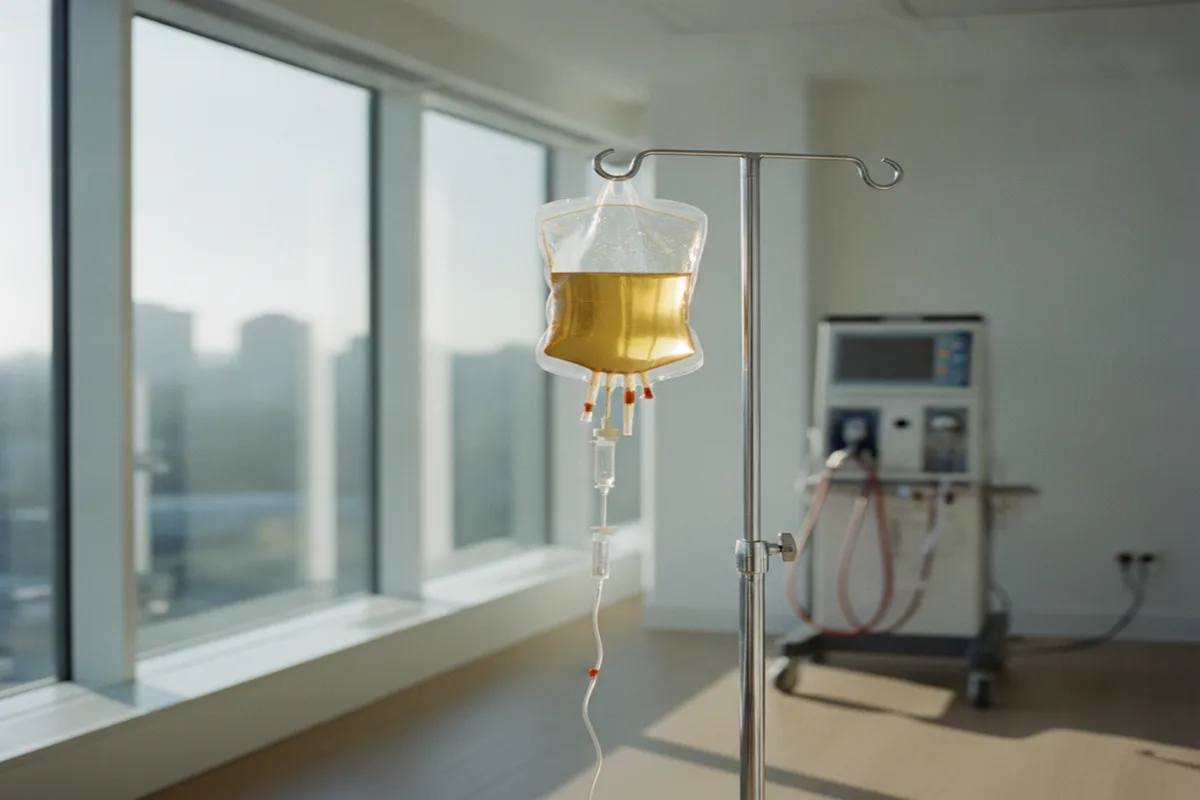
A 2025 trial found swapping out old plasma rejuvenated 15 aging clocks — while another found the opposite. The honest science.
Scientists just dosed the first person with a therapy designed to make aged cells young again — and it started in the eye. The honest science.
Your immune system has an age of its own — the 2026 science on immunosenescence, inflammaging, and what actually slows it.
A wave of 2026 research keeps arriving at the same point: staying busy is not the same as training — and grip strength predicts survival.

The same reaction that browns toast is stiffening your skin and arteries — and scientists just reversed some of it.
Biohackers dose the 150-year-old blue dye for focus and longevity. The honest human evidence.
A 2026 study raced 14 aging biomarkers against death. One DNA-based clock won — what it measures, and its limits.

A new 2026 study links this cheap cell metabolite to a younger biological age. The honest science.
The “Wolverine peptide” is everywhere. What the science actually shows.
Famous for muscle — but what does it really do for the aging brain?
What the research actually supports — and where marketing runs ahead.
Forget the $80 powders. A few cheap, boring basics have the real evidence.
Every guide, organised into three deep-dive hubs.
NAD+, NMN, spermidine, omega-3, peptides, rapamycin — what the human trials actually support, and what's hype.
Explore supplements → 🏃VO₂ max, sleep, protein, sauna and fasting — the free daily basics with the strongest evidence for a longer life.
Explore habits → 💉Ozempic and aging, the muscle trade-off, microdosing and natural alternatives like berberine — the evidence.
Explore GLP-1 →Interactive, science-based calculators — no sign-up, instant results.
Estimate your biological age from your lifestyle in about 60 seconds.
Try it →Score your daily habits 0–100 and see your top 3 highest-impact gaps.
Try it →Estimate your VO₂ max without a treadmill test — find your fitness age.
Try it →Your daily protein target in grams, from weight, age, activity and goal.
Try it →Work out your weekly sleep debt — and how to pay it back.
Try it →Fresh research, broken down — every week.
The next drug in the Ozempic saga hits three hormone systems at once and posts the biggest weight-loss numbers short of surgery — here is what it means for aging.
A wave of 2026 research says your immune system ages on its own — immunosenescence, inflammaging, and what genuinely slows the drift.
One gene, three versions — one turns up in centenarians, one is the top risk gene for Alzheimer’s. New 2026 science on how it protects the aging brain.
The internet’s newest blue “brain tonic” has real mitochondrial science — and a failed Alzheimer’s trial. The honest evidence.
One is the molecule your cells run on, the other is a building block — and that changes which you should take.
The autophagy-triggering compound in wheat germ and aged cheese — benefits, foods and safety.
What the trials show, what side effects to expect, and how to spot a product worth the money.
A daily multivitamin nudged five biological-age clocks in a 958-person Harvard trial. The effect was real — and smaller than the headlines.
A 2026 model puts the ceiling on human life near 156 years — set by DNA damage in cells that never divide. What that number really means.
Mice with extra klotho live longer, and low levels predict earlier death in people. The honest science — and how exercise raises your own.
Social media calls it “nature’s Ozempic.” The real evidence on blood sugar, weight and the viral hype.
Up to 40% of the weight lost on GLP-1 drugs can be muscle — the tissue that keeps you strong as you age. The science, and how to protect it.
The “Wolverine peptide” is all over fitness forums and clinics. The honest 2026 evidence — and the human data gap.
2026’s buzziest longevity trend is a fraction of a weight-loss shot — taken by people who don’t need to lose weight. The honest science.
Clinics charge six figures to turn back your clock; a viral diet study promises years off in a month. The honest evidence.
A 2026 randomized trial found semaglutide slowed a validated aging clock by 9%. The signal — and the catch.
A saturated fat we were told to avoid is being called the first new essential fatty acid in 90 years.
An obscure mushroom antioxidant falls with age and made mice live longer. The honest science.
A top journal called it a driver of aging. The animal data dazzle; the human data are contested.
One of the few supplements to move a validated aging clock in a real randomised trial.
Stunning animal data, real human risks, and what we still don’t know.
One fitness number predicts lifespan better than almost any other — and how to raise it.
The human data — not the mouse hype — on the supplement everyone’s talking about.
Your body uses protein less efficiently with age — exactly when most people cut back.
Regular sauna bathing tracks with big drops in heart and all-cause mortality.
You can’t biohack your way around bad sleep. The most underrated tool you have.
A Nature Medicine trial put fasting head-to-head with plain calorie cutting.
No fluff, no overpriced miracle powders — just what the research actually supports, straight to your inbox. Unsubscribe anytime.