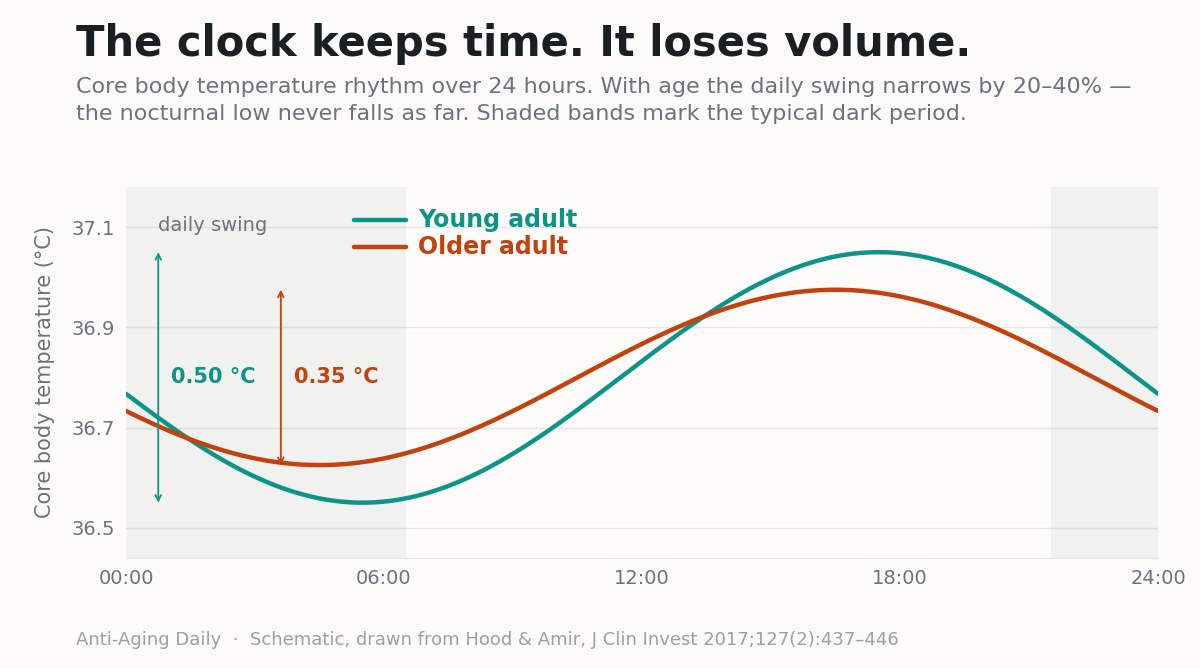
Ask most people what happens to their body clock with age and they describe the symptoms accurately: waking at 4 a.m., fading at 9 p.m., sleep that breaks into pieces. The usual interpretation is that the clock drifts earlier and gets sloppy.
That is only half right, and the half it gets wrong turns out to matter. The clock's timing holds up reasonably well. What collapses is its amplitude — the size of the daily swing. And in 2026 a group in Beijing showed, in mice, that amplitude is not just a readout of aging. It may be a lever on it.
The part of the clock that actually ages
Every day your core body temperature rises and falls by roughly half a degree Celsius, bottoming out in the small hours. Cortisol spikes before you wake. Melatonin (C13H16N2O2) climbs at dusk. Thousands of genes switch on and off on the same schedule. The height of those waves is the amplitude.
In older adults the waves get shallower. A review in the Journal of Clinical Investigation put a figure on the best-measured one: the amplitude of the core body temperature rhythm decreases in older adult men by 20% to 40%, so the nocturnal low never falls as far as it does in a younger person.[1]
The hormonal side is stranger than a simple decline. In aged women, serum melatonin concentrations were comparable to those of young women — yet melatonin's ability to lower core temperature was markedly impaired, and the temperature rhythm amplitude was reduced.[2] The signal was being sent. The body had stopped listening.
That distinction is the whole story in miniature. An aging circadian system is less a stopped clock than one whose hands have faded until the rest of the body can no longer read them. Organs keeping their own peripheral clocks stop getting a confident answer to "what time is it?" and drift out of step. The same machinery sits behind the glymphatic clearance that runs mostly at night, a process that depends on knowing which part of the day it is.
Turning the volume back up in old mice
Eric Erquan Zhang's group and colleagues asked the obvious follow-up question: if amplitude falls with age, what happens if you push it back up?
Their answer, published in Cell in April 2026, was 3'-deoxyadenosine (C10H13N5O3), better known as cordycepin.[3] Given to aged mice on a circadian-phase-optimised schedule, it strengthened the rhythmicity of neurons in the hypothalamic paraventricular nucleus (PVN) — notably not the suprachiasmatic nucleus, the famous master clock, but the downstream hub that converts clock time into hormonal output.
What followed reads like a list of separate anti-aging results. Clock synchrony was restored. Hormonal rhythms, including corticosterone, regained their swing. Immune and metabolic homeostasis improved, tissues resynchronised, and muscle, cardiac and cognitive function improved. Epigenetic age fell. Lifespan in the aged animals extended by roughly 12%.
Two control experiments make this more than a promising compound. First, the authors knocked out Ruvbl2 specifically in the PVN — and every benefit of the drug vanished.[3] So the effect runs through one identifiable molecular route in one small brain region, not through some vague systemic tonic.
Second, and more striking: they reproduced the benefits using chemogenetic activation of those same PVN neurons, with no drug at all. In other words the active ingredient was never really the chemical. It was the amplitude. Nature Reviews Drug Discovery picked the paper up under a title that captures the shift neatly — "Dialling up the circadian clock to target ageing."[4]
And the timing was not a detail. Phase-optimised dosing worked; the same molecule at the wrong point in the animal's day did not. The schedule was part of the intervention.
Why the supplement shelf is not a shortcut
Cordycepin is the best-known bioactive compound in Cordyceps militaris, which you can buy in capsules in any health shop. The reflex is predictable, and it is wrong. Four reasons:
The molecule barely survives you. Cordycepin is rapidly deaminated by adenosine deaminase into an inactive metabolite. Its half-life is about 1.6 minutes after intravenous administration, and oral bioavailability sits under 20%.[5] Research groups chasing cordycepin as a drug have spent years on prodrugs, nanocarriers and enzyme inhibitors precisely because swallowing it does not work.
There is no human schedule to copy. The entire result hinged on dosing at a specific circadian phase in a nocturnal animal. A mouse's biological night is your working day. Nobody has published the human equivalent, and guessing at it discards the one variable the study proved was essential.
It was male mice only. The authors say so in their title — honest, and a real limitation, since circadian and hormonal aging differ by sex.
Capsules are not standardised to cordycepin. Cordyceps supplements vary enormously in actual cordycepin content, and most labels do not quantify it at all.
This is a drug target, not a protocol. Treating it as a protocol is how good science becomes a bad purchase — the same pattern we traced through the longevity supplement market.
What human data already say about amplitude
Here is what makes the mouse paper worth your attention: the same variable has already been measured in people, at scale.
In October 2024, researchers published an analysis of 88,905 UK Biobank participants, mean age 62.4, who wore wrist light sensors for a week — about 13 million hours of personal light exposure — followed for a mean of eight years, with 3,750 deaths recorded.[6] The gradient was steep and went in both directions:
| Exposure | Association with all-cause mortality |
|---|---|
| Night light, 70th–90th percentile | 15–17% higher risk |
| Night light, 90th–100th percentile | 21–34% higher risk |
| Brighter day light | Incrementally lower risk |
| Low modelled circadian amplitude | Higher risk |
| Circadian phase shifted earlier or later | Higher risk |
Read the last two rows again. Suppressed circadian amplitude was itself a mortality signal in humans — the identical variable the Beijing group manipulated in mice. That is an unusual degree of convergence between a mechanism study and a cohort study.
A companion analysis from the same group looked at regularity rather than light. Using a sleep regularity index built from accelerometer data, the four most regular quintiles had 23% to 48% lower all-cause mortality than the least regular quintile, with 27% to 57% lower cardiometabolic mortality and 17% to 39% lower cancer mortality.[7] Regularity predicted mortality more strongly than sleep duration did.
Which is worth sitting with, because duration is the question everyone asks. If you came here from how much sleep you need for longevity, the honest answer may be that the hours are the less important number.
The levers that are genuinely yours
Nothing below is new advice. What is new is the reason for it. You are not chasing hours of sleep; you are defending the amplitude of a signal that fades with age.
Build contrast, not comfort. Amplitude is a function of the gap between your brightest and darkest hours. Ordinary indoor lighting runs roughly 100–500 lux; an overcast morning outdoors is several thousand. You cannot manufacture that contrast indoors, which is why "sit near a window" underperforms "step outside for fifteen minutes."
Make nights actually dark. The mortality gradient in the PNAS data was measured across ordinary bedrooms, not laboratories — street light through thin curtains, a television left on, a bright bathroom at 3 a.m.
Fix wake time before bedtime. Regularity carried the stronger signal, and wake time is the anchor light exposure and meals hang off.
Treat meal timing as plausible, not proven. Eating on a consistent daytime schedule is mechanistically well aligned with circadian biology, but as we covered in the intermittent fasting evidence, the human outcome data remain thinner than the enthusiasm.
These sit alongside, not above, the habits with the strongest evidence behind them. Circadian hygiene is a multiplier on sleep, exercise and metabolic health — not a replacement for any of them.
What we still do not know
There is no practical way to measure your own circadian amplitude. Doing it properly requires dim-light melatonin onset sampling or a constant-routine laboratory protocol. Wearables estimate rest–activity rhythms, which correlate with clock amplitude but are not the same thing, and no consumer device validly reports it.
We do not know whether restoring amplitude late in human life helps. The mice were already old at treatment, which is encouraging, but mouse lifespan extensions have a poor record of translating.
And the human evidence is entirely observational. People with bright nights and irregular schedules differ from everyone else in ways no adjustment fully removes — shift work, illness, poverty, undiagnosed disease — and a wrist light sensor sits under a sleeve. These studies establish that circadian amplitude belongs on the list of aging biomarkers. They do not establish that fixing yours adds years.
What changed in 2026 is the direction of the arrow. For two decades circadian disruption was treated as a consequence of aging — something that happens to you on the way down. The PVN result makes the more interesting claim: that the flattening is upstream, and that a clock turned back up can drag part of the system with it. That is a target worth watching, and it will not be found in a capsule.
Common questions
Does your circadian rhythm really affect how fast you age?
The strongest causal evidence is still in animals: restoring circadian amplitude in the PVN of old mice lowered epigenetic age and extended lifespan by about 12%, and the benefit vanished when the timing was wrong.[3] In humans, low modelled circadian amplitude independently predicted higher mortality in 88,905 adults — observational, but the same variable.[6]
Can I take Cordyceps or melatonin to fix my body clock?
Cordyceps will not reproduce the mouse study: cordycepin is deaminated within minutes, oral bioavailability is under 20%, and the result depended on a dosing phase nobody has translated to humans.[5] Melatonin has its own twist — aged women showed levels comparable to young women but a markedly blunted response,[2] suggesting the bottleneck is downstream signalling, not hormone supply. Discuss it with a clinician rather than self-prescribing.
What is the single most effective thing I can do?
Keep the same wake time every day, weekends included — regularity outpredicted duration in the UK Biobank accelerometer data.[7] Then add contrast: bright outdoor light soon after waking, a genuinely dark bedroom. Both are free and both target amplitude directly. For wider context, the biological age calculator and brain aging after 50 are the natural next reads.