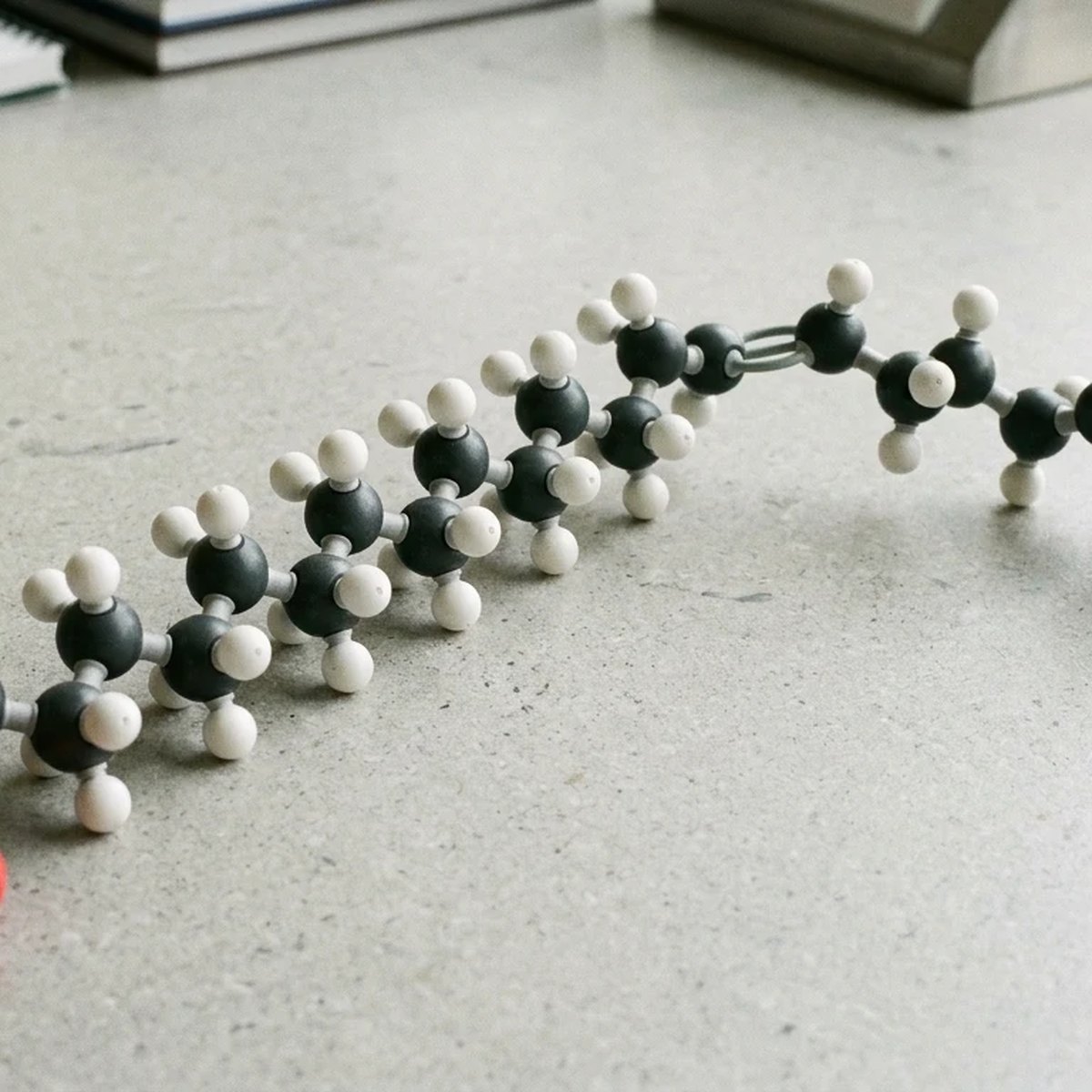
Most people meet this molecule under its common name. Cis-15-tetracosenoic acid is the systematic label; everyone else calls it nervonic acid, and the name is not marketing. It was pulled out of nerve tissue, and that is still where it matters most. In the human body this fatty acid is concentrated in the sphingolipids of myelin, the fatty insulation wrapped around nerve fibres that lets signals travel fast and cleanly.[1]
That biography has made nervonic acid a recurring candidate in brain-health and longevity circles: if myelin thins with age, and if this is the fat myelin is partly built from, the supplement pitch writes itself. The honest version is more interesting and considerably more cautious, because the two most important questions — does swallowing it reach your brain, and is more of it in your blood actually good — both have uncomfortable answers.
The chemistry, in plain terms
Nervonic acid has the formula C24H46O2: a chain of twenty-four carbons with a single double bond, which makes it a monounsaturated very-long-chain fatty acid. The two naming systems can be confusing, and both describe the same bond. Counting from the acid end, the double bond sits between carbon 15 and carbon 16 — hence cis-15-tetracosenoic acid. Counting from the opposite, methyl end, it is the ninth carbon along, which makes it an omega-9 fat and earns it the shorthand C24:1 n-9.[1] In other words it belongs to the same family as oleic acid, the main fat in olive oil — just far longer.
That relationship is literal. Your cells build nervonic acid by elongating oleic acid (C18:1) two carbons at a time, through C20:1 and C22:1, using a family of enzymes called elongases. For the final steps to C24, the key enzyme is ELOVL1.[2] So nervonic acid is not classed as an essential fatty acid: you can make it. Whether you always make enough, in the right cells at the right time, is the question the research has been circling for thirty years.
Why myelin cares about chain length
Myelin is unusual tissue. It is roughly 70–80 per cent lipid by dry weight, and a large share of that is sphingolipid — sphingomyelin and cerebrosides — rather than the ordinary phospholipids that make up most cell membranes. Sphingolipids are built around a long fatty acid tail, and in myelin those tails are disproportionately twenty-four carbons long. Nervonic acid is the dominant unsaturated version.[1]
The length matters mechanically. Very-long-chain tails can span and interdigitate between the two leaflets of the membrane, effectively stitching the tightly stacked myelin wraps together. The single cis double bond stops that packing from becoming rigid, keeping the sheath stable but not brittle. This is not a vague "brain food" claim; it is structural chemistry, and it is why nervonic acid turns up again and again in lipid analyses of white matter.
The strongest evidence is genetic, not nutritional
If you want to know whether C24 fatty acids are genuinely important for myelin, the cleanest experiment is one nobody would run deliberately: find people whose elongase is broken. Those people exist. Mutations in ELOVL1, the enzyme that makes the C24 step, cause a severe syndrome that includes hypomyelination — a failure to build normal myelin — alongside ichthyosis, spastic paraplegia, deafness and optic atrophy.[3] A later series described biallelic ELOVL1 variants in patients with hypomyelinating leukodystrophy and movement disorder.[4]
This is the firmest point in the whole field: when the body cannot produce C24 fatty acids properly, myelin suffers badly. What it does not show is the reverse — that adding more nervonic acid to a normally functioning adult improves anything. That is a different claim, and it is where the evidence thins out.
Babies, myelin and a measurable window
The developmental data are more persuasive than the adult data. Myelination runs fastest in late gestation and the first two years of life, and nervonic acid tracks it. In a study of 28 premature infants, the proportion of nervonic acid in red-blood-cell sphingomyelin rose from 9.9 per cent to 12.8 per cent between roughly 32 and 37 weeks of post-conceptional age — and it rose in every feeding group, whether the infants received human milk or formula.[5] The authors proposed the measurement as a peripheral index of brain maturation.
That detail cuts both ways. The rise happened regardless of what the infants were fed, which suggests it was driven by developmental programming rather than dietary supply. Human milk does contain nervonic acid, but in small amounts, and a 2025 review argues this is a gap worth closing in infant formula — a review written by authors employed at a company developing a nervonic acid oil for exactly that market.[6] The idea may well be right. It is also not disinterested, which is a pattern this field shares with C15:0, the dairy fat now marketed as the first new essential fatty acid in 90 years.
The demyelination hypothesis, and thirty years of not quite proving it
The therapeutic idea is old. In 1994, Sargent and colleagues proposed in Medical Hypotheses that supplying nervonic acid could help in demyelinating disease such as multiple sclerosis, on the logic that remyelination requires the raw material.[7] Three decades later the supporting work is still mostly preclinical. A 2019 cell study found that a naturally occurring nervonic acid ester improved myelin synthesis by human oligodendrocytes in culture.[8] Follow-up work from the same group framed nervonic acid precursors as components of a profiled lipid supplement for central nervous system regeneration.[9] In animals, nervonic acid has shown metabolic effects too: it limited weight gain in a mouse model of diet-induced obesity.[10]
Encouraging, but note what is missing. There is no randomised controlled trial in humans showing that nervonic acid supplementation changes a clinical outcome — not in multiple sclerosis, not in cognitive decline, not in healthy aging. Cell cultures and mice are where good hypotheses start, not where they are settled.
The inconvenient finding nobody markets
Here the story takes a turn that supplement pages tend to leave out. A 2026 study in GeroScience screened serum from older adults with normal cognition, mild cognitive impairment and dementia, looking for circulating molecules that suppress mitochondrial function. Nervonic acid came out as one of two lead candidates: it was associated with worse bioenergetic capacity and worse cognition, and when applied directly to neurons, myoblasts and fibroblasts it inhibited the electron transfer system.[11] Separately, red-blood-cell fatty acid profiling in mild cognitive impairment and Alzheimer's disease has found very-long-chain saturated fats, including lignoceric acid (the saturated twin of nervonic acid), significantly elevated rather than depleted.[12]
None of this proves nervonic acid causes harm. Elevated levels in disease may be a consequence of membrane turnover rather than a cause of anything. But it does demolish the simple version of the story. "This fat is in myelin, therefore more of it in your blood is better" is not a claim the human data support, and anyone selling it should be asked about the GeroScience result.
Where nervonic acid actually comes from
Dietary sources are genuinely unusual. Ordinary foods supply very little: traces in fish, in dairy sphingolipids and in some seeds. The commercial supply comes from a handful of plants that store it in their seed oil, and from recent fermentation-derived oils.
| Source | Nervonic acid (% of fatty acids) | Notes |
|---|---|---|
| Malania oleifera seed oil | about 46–50% | The richest known source. Also 31% oleic and 14% erucic acid. The tree is rare and protected in China.[13][14] |
| Lunaria annua (honesty) seed oil | high, alongside erucic acid | The oil used in the classic feeding experiments; rich in both C22:1 and C24:1.[15] |
| Acer truncatum (purpleblow maple) seed oil | a few per cent | Approved as a food oil in China; the most widely available commercial source.[1] |
| Human milk | trace | Present in small amounts; proposed as a fortification target for infant formula.[6] |
| Fish, dairy, seeds | traces | Not a meaningful dietary source at normal intakes.[1] |
The erucic acid problem
This is the practical safety issue, and it is arithmetic rather than speculation. The plant oils richest in nervonic acid are also rich in erucic acid (C22:1), the one step below it on the elongation chain. In Malania oleifera oil, erucic acid makes up about 13.5 per cent of fatty acids.[14] The European Food Safety Authority has set a tolerable daily intake for erucic acid of 7 mg per kg of body weight per day, based on heart muscle changes seen in animal studies.[16]
Run the numbers for a 70 kg adult. The tolerable daily intake works out at about 490 mg of erucic acid. One gram of Malania oil delivers roughly 500 mg of nervonic acid — and roughly 135 mg of erucic acid with it, around a quarter of the daily allowance from that one capsule, before counting the erucic acid already in rapeseed-based foods. Refined products enriched for nervonic acid shift that ratio, which is exactly why the purification step matters and why a label that does not state its erucic acid content is telling you something.
Does an oral dose even reach your brain?
The most useful experiment on this question is also the oldest, and the result is sobering. Researchers fed Lunaria oil rich in C22:1 and C24:1 to quaking mice, a strain with a myelin defect, and measured sphingomyelin fatty acids in several tissues. Nervonic acid rose markedly in liver, red blood cells and milk — so the fat was absorbed and distributed. In the brain, the effect appeared only in pups exposed through their mothers before or just after birth. The authors concluded that the nervonic acid in myelin sphingomyelin is probably made locally, by chain elongation inside oligodendrocytes, from shorter precursors.[15]
If that holds in humans, it reframes everything. The limiting factor for myelin would not be the supply of finished nervonic acid in your bloodstream, but the elongation capacity of the cells that build myelin — which supplementation does not obviously fix. It also fits the ELOVL1 genetics: the disease comes from a broken enzyme, not an empty plate.
What a sensible person does now
There is no established human dose for nervonic acid, no clinical trial supporting a target intake, and no deficiency syndrome defined in adults. Commercial products typically supply somewhere between 100 and 500 mg a day, a figure derived from what the oils conveniently contain rather than from any dose-finding study.
Given that, three positions are defensible. If you take it, choose a product that discloses its erucic acid content and treat it as an experiment, not a therapy. If you have a demyelinating condition, discuss it with your neurologist rather than self-prescribing — the evidence is at the cell-culture stage. And if you want the measures with actual human outcome data behind them for brain aging, they are the unglamorous ones: blood pressure control, sleep, hearing correction, resistance training and enough protein to keep muscle on your frame. Our protein calculator covers the last of those, and the glymphatic system explains why the sleep part is not optional.
Nervonic acid is a real and important molecule with a specific structural job. That is not the same as a reason to buy it.
Common questions
What is cis-15-tetracosenoic acid?
It is the systematic chemical name for nervonic acid, a monounsaturated very-long-chain fatty acid with the formula C24H46O2. The chain is 24 carbons long with one cis double bond between carbons 15 and 16, counted from the acid end. Counted from the methyl end the same bond is at position 9, so it is also written C24:1 n-9 and belongs to the omega-9 family.
Is nervonic acid the same as cis-15-tetracosenoic acid?
Yes, they are two names for one molecule. "Nervonic acid" is the common name, given because the fatty acid was first characterised in nerve tissue. "Cis-15-tetracosenoic acid" is the systematic name: tetracosenoic means a 24-carbon chain with one double bond, cis-15 specifies where that bond is and its geometry.
What does nervonic acid do in the body?
Its main structural role is as the fatty acid tail of sphingolipids — sphingomyelin and cerebrosides — in myelin, the insulating sheath around nerve fibres. Its unusual length lets it span and lock together the tightly packed myelin membranes, while the single double bond keeps the structure from becoming rigid. It is also present in liver and kidney.
Is nervonic acid an essential fatty acid?
No. The human body can synthesise it by elongating oleic acid through C20:1 and C22:1 to C24:1, mainly via the enzyme ELOVL1. That is why mutations in ELOVL1 cause hypomyelination: the problem is a broken enzyme rather than a missing nutrient. There is no defined dietary requirement and no recognised deficiency syndrome in adults.
Which foods contain nervonic acid?
Almost none in meaningful amounts. Ordinary diets supply only traces, from fish, dairy sphingolipids and some seeds. The commercial supply comes from seed oils: Malania oleifera (about 46–50 per cent of its fatty acids), Lunaria annua, and Acer truncatum, which is approved as a food oil in China. Human milk contains small amounts.
Does taking nervonic acid increase it in the brain?
Not reliably in adults, on the evidence available. In the best-known feeding study, dietary nervonic acid raised levels in liver, red blood cells and milk, but brain sphingomyelin changed only in pups exposed through the mother before or shortly after birth. The authors concluded that myelin nervonic acid is largely made on site by oligodendrocytes from shorter precursors, which would make blood supply the wrong bottleneck to target.
Is nervonic acid safe to supplement?
No serious toxicity has been reported at the doses used in products, but the relevant safety question is the company it keeps. Nervonic-acid-rich seed oils also contain erucic acid, for which the European Food Safety Authority set a tolerable daily intake of 7 mg per kg of body weight. In an oil containing about 13.5 per cent erucic acid, a gram of oil carries roughly 135 mg of it — a meaningful share of a 70 kg adult's daily allowance. Products that do not declare erucic acid content are worth avoiding.
Does nervonic acid help with multiple sclerosis or memory?
There is no randomised controlled trial in humans showing benefit for either. The case rests on biology, cell cultures and animal models. One large caution runs the other way: a 2026 study found circulating nervonic acid was higher in people with Alzheimer's dementia and inhibited mitochondrial function in cultured cells, so higher blood levels are not automatically a good sign.
How much nervonic acid should I take?
There is no evidence-based dose. Supplements typically provide 100–500 mg a day, a range that reflects what the source oils conveniently contain rather than any dose-finding research. Without human outcome trials, any number quoted on a label is a commercial choice, not a clinical recommendation.