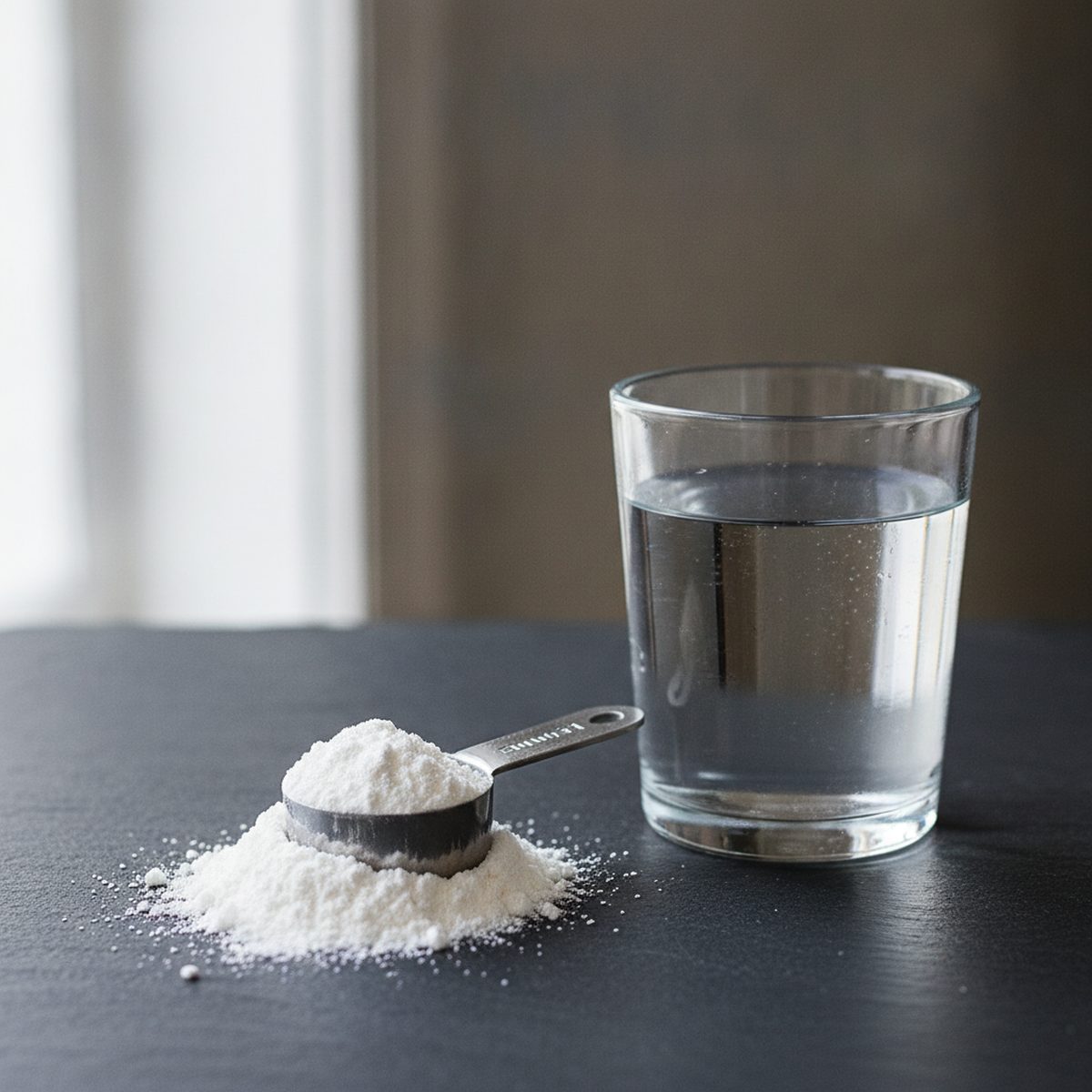
Ask most people what creatine does and they'll picture a tub in a gym bag. For thirty years it has been the bodybuilder's staple — one of the few sports supplements that actually works, reliably adding a bit of strength and size. But over the last few years, and with a fresh crop of trials landing in 2024 and beyond, researchers have been asking a more interesting question: if creatine fuels hard-working muscle, what does it do for the hardest-working, most energy-hungry organ you have — your brain? It is a question that lands differently depending on your starting risk, which for brain aging is shaped more than anything by a single gene called APOE. This is the honest account of what the science shows, where it's strong, and where the excitement is running ahead of the data.
What creatine actually is
Creatine (chemical formula C4H9N3O2) is a small compound your body already makes, mostly in the liver and kidneys, from three amino acids. You also eat it — it's concentrated in meat and fish, which is why vegetarians and vegans carry noticeably lower stores. About 95% of it sits in your muscles, but a meaningful amount lives in the brain, and that's the part this story is about.
Its job is energy logistics. Cells run on a molecule called ATP, and when a cell suddenly needs a burst of power, creatine — stored as phosphocreatine — hands over a phosphate group to regenerate ATP almost instantly. Think of it as a rechargeable battery that smooths out spikes in demand. Muscle needs that during a heavy lift. But the brain, which burns roughly a fifth of your body's energy at rest, needs steady, resilient energy supply too — and it turns out the same buffering system operates between your ears. That shared mechanism is the whole reason anyone thought to test creatine for cognition in the first place.
Start with what's rock solid: muscle and aging
Before the brain, it's worth grounding the discussion in creatine's best-established benefit for older people, because it's directly an anti-aging story. From around your forties onward you steadily lose muscle — a process called sarcopenia — and that loss is one of the clearest drivers of frailty, falls and lost independence in later life. Creatine is one of the few supplements shown to help, but with an important condition attached: it works when you also lift.
According to PubMed, a 2017 meta-analysis of 22 randomized trials in 721 older adults found that creatine combined with resistance training produced significantly greater gains than training alone — about 1.4 kg more lean tissue mass, plus measurable increases in chest-press and leg-press strength.[5] A later 2021 analysis confirmed the pattern and clarified the dosing: the benefit holds across strategies, and you don't need to megadose to get it.[6] The takeaway is unglamorous but real — creatine is a useful add-on to strength work in later life, not a substitute for it. If you want the fuller picture on protecting muscle as you age, we've covered the food side in protein after 40 and the cardio-fitness side in VO₂ max and longevity.
Now the brain: what the trials actually found
The cognitive research is younger and messier, but it has matured enough to say something useful. Two systematic reviews are the anchors. According to PubMed, a 2023 meta-analysis of randomized trials found that creatine improved memory in healthy people overall — a small effect — but with a striking split by age: in older adults aged 66 to 76 the benefit was large, while in younger people aged 11 to 31 it was essentially zero.[2] In other words, the people with the most to gain were the ones whose brains were already under age-related strain.
A broader 2024 meta-analysis of 16 trials in 492 adults widened the lens beyond memory. It found significant improvements in memory, in attention time, and in information-processing speed — but not in overall cognition or executive function, and the benefits were most pronounced in people with a disease, in adults under 60, and in women.[1] That mixed result is exactly what an honest reader should expect from a real, modest effect: it shows up on some measures and not others, and it depends on who's taking it. A 2026 review focused specifically on older adults reached a similar, cautious conclusion — five of six studies pointed to a positive link between creatine and cognition, especially memory and attention, but the authors flagged that much of the evidence is still low quality and that better trials are needed.[3]

The clearest signal comes when the brain is stressed
If there's a through-line in this research, it's that creatine helps most when your brain's energy supply is under pressure — from age, from a meat-free diet, or from sheer exhaustion. The exhaustion case produced one of the more eye-catching recent findings. According to PubMed, a 2024 study gave sleep-deprived volunteers a single high dose of creatine (0.35 g/kg — far above a normal daily serving) during a night without sleep, and tracked their brain chemistry and performance. The single dose partially reversed the metabolic dip that sleep loss causes in the brain and improved both cognitive performance and processing speed over the following hours.[4]
It's a genuinely interesting result — the first good evidence that a single dose can reach the brain quickly enough to matter, when researchers had assumed it took weeks. But keep it in proportion: it was one small study, using a dose several times higher than anyone takes routinely, in the artificial setting of enforced sleep deprivation. It's a promising signpost, not a licence to skip sleep and dose up. If anything, it reinforces a theme this magazine keeps returning to — the basics do the heavy lifting, and no capsule substitutes for actually sleeping.
A note on women
One recurring finding worth pulling out is that women may be an especially good fit for creatine, and are badly understudied. The 2024 cognition analysis found the effect more pronounced in females, and the International Society of Sports Nutrition's position stand on female athletes singles creatine out as one of the few supplements with strong evidence in women — recommending 3 to 5 grams a day, and noting that post-menopausal women in particular may benefit across bone health, mood and skeletal muscle, sometimes at higher doses.[7] Given that women have historically been left out of supplement trials, this is an area where the evidence is likely to grow.
How much, and is it safe?
The practical details are refreshingly simple. The standard dose is 3 to 5 grams of creatine monohydrate a day — the plain, cheap, decades-old form that still outperforms the fancier variants on evidence. You'll read about a “loading phase” of 20 grams a day for a week; that fills muscle stores faster but isn't necessary, and for the brain it's largely beside the point, because brain creatine rises slowly regardless. Consistency matters more than timing: it's the daily habit over weeks that builds the stores.
On safety, creatine has one of the strongest records of any supplement on the shelf. According to PubMed, the International Society of Sports Nutrition's position stand concluded that creatine is safe and well-tolerated at intakes up to 30 grams a day for as long as five years, in populations ranging from infants to the elderly, and that a habitual low intake of around 3 grams a day may carry health benefits across the lifespan.[8] The persistent worry about kidneys is largely a misunderstanding: creatine can nudge up blood creatinine, a byproduct used to estimate kidney function, which can make a routine test look off even though nothing is wrong with the kidney itself. People with established kidney disease, and anyone pregnant, should still clear it with a clinician — but for healthy adults the safety margin is wide.
An honest verdict
Creatine is a rare thing in the supplement world: cheap, extensively studied, and backed by real data rather than vibes. Its muscle benefit for older adults — when paired with resistance training — is about as solid as supplement science gets, and that alone makes it worth considering as you age. The brain story is younger and more modest: a small but genuine memory effect that grows with age, some help with processing speed and attention, and a striking ability to prop up cognition when the brain is stressed by sleep loss or a low-creatine diet. What it is not is a nootropic miracle that will sharpen an already young, rested, well-fed brain.
So who should actually care? If you're older, vegetarian, female, or routinely running on too little sleep, creatine sits in the sweet spot where the evidence is most encouraging — and it's inexpensive and safe enough that a trial of 3 to 5 grams a day is a reasonable, low-risk experiment. Treat it as a well-supported supporting player, not the star. The interventions with the deepest longevity evidence — strength training, aerobic fitness, real sleep, decent protein — are still doing far more for your brain and body than anything you can scoop from a tub. Creatine's honest role is to complement those, not replace them. For where it fits among the options actually worth your money, see our guide to longevity supplements.
Common questions
Does creatine actually improve memory and brain function?
Modestly, and mostly when the brain is under stress. Meta-analyses of randomized trials find creatine gives a small but real improvement in memory, with a much larger effect in older adults aged 66 to 76 than in young people, and some benefit for processing speed and attention. It does not reliably boost overall cognition or executive function in young, well-rested people. The strongest gains show up in older adults, vegetarians, and people who are sleep-deprived or otherwise stressed.
How much creatine should I take for brain benefits, and do I need to load?
The standard dose is 3 to 5 grams of creatine monohydrate per day, taken consistently. You do not need a loading phase for brain benefits. Brain creatine stores rise more slowly than muscle stores, so the relevant effects build over weeks of daily use rather than days. Some brain-focused research has used higher acute doses, but for everyday use a steady 3 to 5 grams a day is the well-supported approach.
Is creatine safe for the kidneys and for long-term use?
For healthy people, the evidence says yes. The International Society of Sports Nutrition concluded that creatine is safe and well-tolerated at up to 30 grams a day for as long as five years across populations from infants to the elderly. Creatine can slightly raise blood creatinine, a marker used to estimate kidney function, but this reflects the supplement itself rather than kidney damage. Anyone with existing kidney disease or who is pregnant should check with a clinician first.