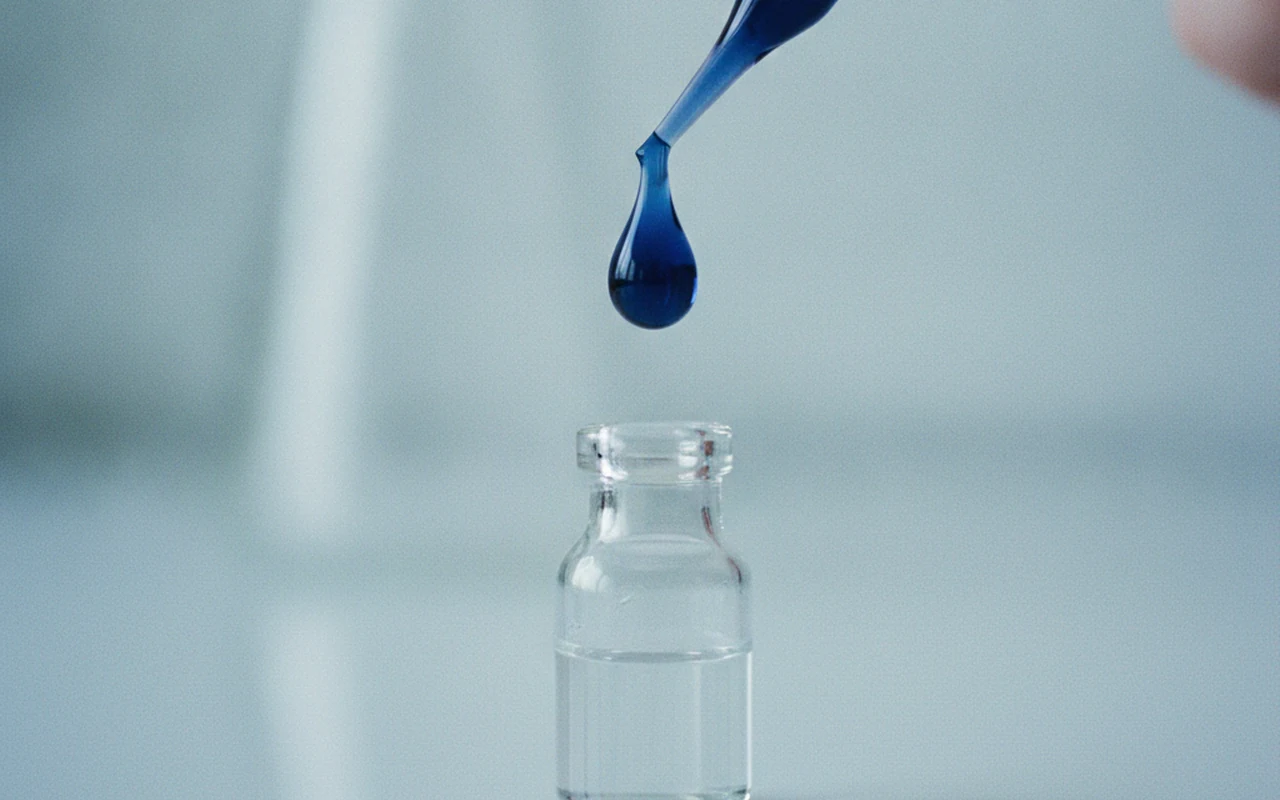
If your feed looks anything like ours this summer, you've seen it: someone squeezing a few drops of an almost fluorescent blue liquid into a glass of water, staining their tongue like a blueberry popsicle, and promising it will sharpen their focus, lift brain fog, and maybe slow down aging itself. Methylene blue — a synthetic dye first cooked up in 1876 to color fabric — has become one of the biohacking world's favorite party tricks. Searches for it spiked sharply in early 2025 after a wave of viral clips, and they haven't really come back down.
What makes methylene blue more interesting than the average supplement trend is that it isn't snake oil dressed up in a lab coat. It's a bona fide pharmaceutical, sitting on hospital shelves for more than a century, with a real and rather elegant mechanism behind it. The problem — as always in this field — is the gap between what the molecule can plausibly do in a cell and what people on the internet claim it does for a healthy human brain. So let's take it seriously and take it apart: what methylene blue is, why the biology is genuinely intriguing, what the human studies actually found, and the safety catch the viral clips almost never mention.
What methylene blue actually is
Methylene blue (chemical formula C16H18ClN3S) is a synthetic compound from the phenothiazine family — the same chemical lineage that later gave us some of the first antipsychotic drugs. It was one of the earliest medicines of the modern pharmaceutical era, used against malaria before better drugs arrived, and it's still an approved treatment today for a rare blood condition called methemoglobinemia, as well as for certain kinds of poisoning. In other words, doctors have given people methylene blue, and watched what it does, for well over a hundred years.
That deep familiarity is exactly why it appeals to biohackers: here is a cheap, off-patent, "grandfathered" drug with a long track record, which they can reframe as a natural-sounding brain and longevity aid. The bright blue color is a bonus for the camera. But its long history in medicine is at doses and settings — usually intravenous, in a hospital — that have little to do with a few drops in a water bottle.
The genuinely clever biology
Here's where methylene blue earns a second look. Deep inside your cells, mitochondria generate energy by passing electrons down a chain of proteins — the electron transport chain — a bit like a bucket brigade handing along fuel. When links in that chain get sluggish or damaged, which tends to happen with age and in disease, energy production drops and harmful free radicals leak out.
In laboratory studies, methylene blue can slip into that process and act as an alternative electron carrier: it accepts electrons and shuttles them further down the chain, effectively bypassing a jammed link and keeping the energy line moving.[1] In cell and animal experiments it increased oxygen consumption, reduced the leak of reactive free radicals, and protected neurons against several kinds of toxic stress — and researchers explicitly framed it as a strategy for the mitochondrial dysfunction seen in aging and neurodegenerative disease.[2] That's a specific, well-mapped mechanism, not a vague "boosts energy" claim. It's the real reason serious scientists — not just influencers — have studied this blue dye for the brain. It taps the same mitochondrial-health thread that runs through compounds like urolithin A.
What the human studies actually show
This is where enthusiasm has to meet the evidence, and the evidence in humans is surprisingly thin. The most-cited study is a small but well-designed one: researchers at UT Health San Antonio gave a single low oral dose of methylene blue or a placebo to healthy adults in a randomized, double-blind, placebo-controlled brain-imaging trial, then scanned their brains during attention and memory tasks. Methylene blue increased functional MRI activity in regions handling sustained attention and short-term memory — and was associated with about a 7% increase in correct answers during memory retrieval.[3] A companion analysis found it strengthened the functional connectivity of brain networks that link perception and memory.[4]
That is a real, measurable effect — and it's genuinely intriguing. But read the size of it honestly. This was a one-time dose in roughly two dozen people, producing a modest bump on a lab memory task, imaged an hour later. It is a long way from "takes drops daily for years and stays mentally young." There is no large, long-term human trial showing methylene blue preserves cognition, prevents dementia, or extends healthy lifespan. The human case, for now, rests largely on that single elegant imaging study — impressive as a proof of concept, slim as a foundation for a daily habit.
The Alzheimer's trials that quietly failed
If methylene blue really rejuvenated the aging brain, the place you'd expect to see it is Alzheimer's disease — and it got a serious, well-funded shot. Beyond its mitochondrial role, methylene blue can interfere with the clumping of tau, one of the toxic proteins that tangles up in Alzheimer's brains. A company developed a stabilised, better-absorbed version of the molecule (called LMTM) and ran it through large, rigorous phase 3 trials.
The headline result was a disappointment. In a 2016 trial published in The Lancet, 891 patients with mild-to-moderate Alzheimer's were randomized to LMTM or a control, and the pre-specified primary analysis found no benefit over control on either cognition or the ability to handle daily activities.[5] Researchers later pointed to hints of benefit in the small subset of people taking it as a standalone therapy, but those were exploratory, after-the-fact findings — the kind that generate a follow-up study, not a conclusion. The blunt takeaway: methylene blue's most ambitious clinical test, in the disease where it had the clearest rationale, came up empty. That is exactly the sort of quiet failure that never trends, while the upbeat mechanism clips rack up millions of views.
The safety catch the clips leave out
Methylene blue's marketing leans hard on its long safety record, and at low doses it is generally well tolerated. But there is one serious interaction that rarely makes it into a 30-second video: methylene blue is a potent inhibitor of monoamine oxidase, the same enzyme targeted by an older class of antidepressants.[6] Combine it with common serotonin-boosting medications — SSRIs and SNRIs, the antidepressants millions of people take — and it can precipitate serotonin syndrome, a reaction that ranges from agitation and racing heart to, in severe cases, dangerously high body temperature and death. Documented cases occurred even with the controlled intravenous doses used in surgery.
For anyone on an antidepressant, that turns a trendy blue tonic into a genuine hazard. Add the more mundane issues — it stains everything (including your urine) a vivid blue-green, and much of what's sold online is aquarium- or laboratory-grade product never purified for human consumption — and the "totally safe, it's been used for 100 years" framing starts to look incomplete. Pharmaceutical-grade methylene blue in a hospital is not the same thing as an unregulated dropper bottle from the internet.
The honest bottom line
Methylene blue is one of the more scientifically legitimate characters in the biohacking circus — and one of the most overstated. The real version: it's a century-old drug with a clever, well-documented ability to keep mitochondrial energy production moving, and a single small human study hinted it can give short-term memory and attention a modest nudge. That's a genuinely interesting molecule worth watching.
The viral version — a blue elixir that clears brain fog, upgrades your mind, and slows aging — runs far ahead of the data. The strongest longevity claims rest on cell and animal work, its biggest clinical test in Alzheimer's failed, and it carries a real, potentially dangerous interaction with some of the most widely prescribed medications on earth. If you're intrigued, the responsible move is a conversation with a doctor who knows your medication list — not a self-prescribed habit off a wellness reel. As usual, the truth is more modest and more interesting than the trend: a remarkable old dye with real biology, still waiting for the human evidence to catch up to the hype. For the bigger picture on which trending compounds actually earn their reputation, see our guide to the longevity supplements actually worth your money, and how the evidence stacks up for creatine and the aging brain.
Common questions
Is methylene blue safe to take?
Pharmaceutical-grade methylene blue has a long medical safety record at low doses, but it is not risk-free as a supplement. Its biggest danger is a drug interaction: methylene blue is a potent monoamine oxidase inhibitor, so combining it with antidepressants such as SSRIs or SNRIs can trigger serotonin syndrome, a potentially life-threatening reaction. It can also cause blue-green urine, and aquarium- or lab-grade products are not purified for human use. Anyone on psychiatric medication should not take it without medical supervision.
Does methylene blue actually improve memory or focus?
In one small randomized, placebo-controlled brain-imaging study, a single low oral dose of methylene blue increased brain activity during attention and memory tasks and was linked to a roughly 7% improvement in correct memory retrieval. That is a real but modest, short-term effect measured in a handful of healthy adults — not proof of lasting cognitive enhancement, and nowhere near the transformation influencers describe.
Didn't methylene blue fail as an Alzheimer's drug?
Yes. A stabilised form of methylene blue called LMTM was tested as a tau-targeting Alzheimer's treatment in large phase 3 trials. The main pre-specified analysis in a 2016 Lancet trial of 891 patients showed no benefit over control on cognition or daily function. That failure is an important reality check on the biggest claims made for the molecule.