Most longevity molecules arrive with a supplement brand attached and a mouse study stretched past its evidence. Ergothioneine is a stranger case. Almost nobody outside a lab can pronounce it, you've been eating it your whole life without knowing, and the scientists most interested in it aren't selling anything — they're nutrition researchers quietly building an argument that this obscure compound might deserve to be called a vitamin. In the last two years that argument got a lot harder to dismiss. Here's the honest version of what ergothioneine is, why it keeps turning up in aging research, and where the hype outruns the evidence.
A vitamin we forgot to name
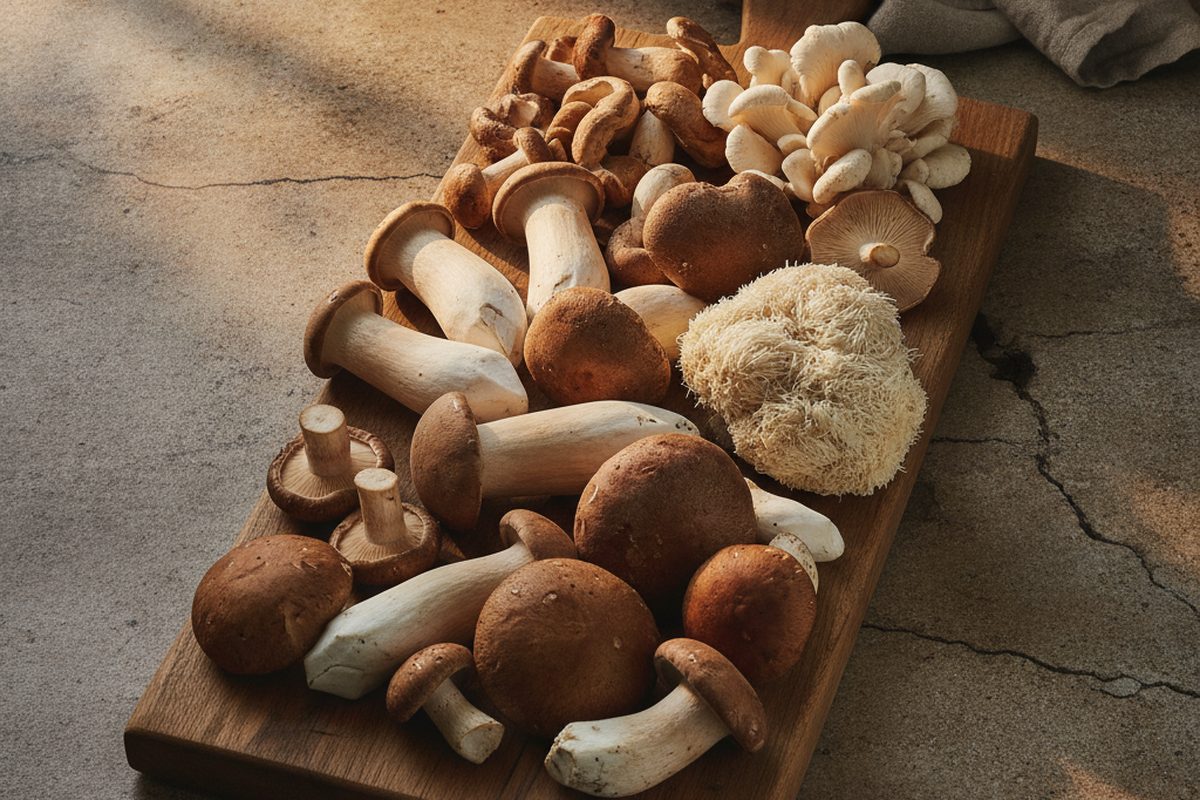
Ergothioneine (chemical formula C9H15N3O2S) is a sulfur-containing amino acid with an unusual property: it's a powerful antioxidant, and your body cannot make a single molecule of it. Every bit you carry came from something you ate. Only certain fungi and a handful of soil microbes actually produce it. Mushrooms are the dietary jackpot — oyster, king oyster, shiitake and porcini are especially loaded — while small amounts trickle into beans, oats, garlic and organ meats because soil fungi pass it up the food chain into plant roots.[5]
Here's the detail that makes biologists sit up. Your cells don't treat ergothioneine as a passing visitor. They pull it out of your blood and hold onto it using a specific, dedicated transporter protein — a gene called SLC22A4, sometimes labelled the “ergothioneine transporter.” The same machinery works in the kidney to reclaim it before it's lost in urine. Evolution doesn't usually build and maintain a bespoke transport-and-recycling system for a molecule that does nothing. That single fact — that the body works hard to keep something it can't produce — is the strongest circumstantial case that ergothioneine matters.[3]
It concentrates in exactly the tissues that take the most oxidative punishment: the liver, kidneys, red blood cells, the lens of the eye, and the brain. Down at the cellular level it does the housekeeping you'd expect of a good antioxidant — mopping up reactive oxygen and nitrogen species, chelating loose metal ions that would otherwise catalyse damage, and helping switch on Nrf2, a master regulator that turns up the cell's own protective genes. It's stable, water-soluble, and unusually good at surviving the trip through digestion intact.[6]
Why they call it a 'longevity vitamin'
The phrase isn't marketing. It comes from the biochemist Bruce Ames, who in a 2018 paper proposed a category he called “longevity vitamins” — nutrients your body can survive without in the short term, but whose long-term shortfall quietly accelerates the diseases of aging. His argument, the “triage theory,” is that when a nutrient runs short the body rations it toward immediate survival and reproduction, starving the slower repair processes that protect your future self. Ergothioneine was one of his headline examples of a compound that might sit in exactly that blind spot: not lethal to lack, but costly to lack for decades.[4]
What turned a theory into a research magnet was a run of human population data. Blood ergothioneine is fairly steady through young adulthood, then starts falling after roughly age 60 — right as age-related disease risk climbs.[3] More provocatively, in large cohort studies people with lower ergothioneine levels showed faster cognitive decline, while those with higher levels had significantly lower rates of cardiovascular death and death from any cause.[3] A separate line of work found that ergothioneine is genuinely scarce in the average American diet, and that industrial farming practices which disrupt soil fungi may be quietly lowering how much reaches our plates in the first place.[5]
This is the same shape of story we've seen with other single molecules that got crowned early — the case for taurine followed almost the same arc, and so did the excitement around cellular antioxidants like glutathione. The lesson from those is worth keeping in your back pocket: a compound that falls with age and correlates with better outcomes is a strong reason to run trials, not a finished conclusion.
The animal evidence got serious
For years ergothioneine's aging case rested on test tubes and cell cultures. That changed. In 2024, researchers in Japan gave male mice a modest daily dose of ergothioneine in their drinking water from young adulthood to the end of their lives. The treated animals lived markedly longer — a clear extension of median lifespan — and, just as important, they aged better along the way: less age-related weight and fat gain, better movement speed in old age, and preserved learning and memory. The researchers tied the brain benefit to healthier hippocampal neurogenesis and a calmer, less inflammatory profile in the brain's immune cells. They saw a matching lifespan boost in the worm C. elegans, a workhorse of aging research.[1]
Then in early 2025 a large European team published a mechanistic study that filled in some of the “how.” In aged rats, ergothioneine improved exercise endurance, muscle mass and blood-vessel growth, and it did so alongside higher NAD+ levels in muscle — the same energy-carrying molecule at the centre of much longevity research. They traced the effect to a surprising route: ergothioneine feeds into hydrogen-sulfide signalling and a chemical tagging of proteins called persulfidation, switching on an enzyme that ultimately raises NAD+. Knock out the pathway, and the benefits vanished — strong evidence the effect is real biology, not a fluke.[2] Reviews mapping ergothioneine onto the classic aging pathways — insulin/IGF-1 signalling, the sirtuins, mTOR — have piled up alongside these results.[6][7]

The catch, stated plainly
Now the discipline. Every headline result above — the longer-lived mice, the stronger rats, the revitalised worms — comes from animals. There is, as of 2026, no long-term human trial showing that ergothioneine supplements slow human aging, prevent dementia, or extend life. The human evidence is entirely observational, and observational data has a permanent Achilles' heel: it can't tell you which way the arrow points. People with high ergothioneine tend to eat more mushrooms, vegetables and whole foods — the diet of people who also exercise, smoke less and have more money for healthcare. Maybe ergothioneine protects their hearts and brains. Or maybe a healthy lifestyle produces both the high ergothioneine and the good outcomes, and the molecule is just riding along as a marker. Current studies genuinely can't separate those.[3]
There's also a gap between the correlation studies and the supplement question. Knowing that naturally higher levels track with lower mortality does not guarantee that swallowing a capsule to raise your levels will reproduce the benefit — the history of antioxidant supplements is littered with exactly that disappointment. And while ergothioneine has looked safe in the short human safety studies done so far, “safe” and “proven to work” are different claims. The molecule earns its research attention. It has not yet earned the word proven.
What a sensible person does now
Strip away the frontier science and a genuinely practical, low-regret answer survives. Mushrooms are the richest natural source of ergothioneine by a wide margin, and a regular serving of cooked mushrooms is cheap, safe, low in calories and delivers the compound in its natural package alongside fibre, B vitamins and other nutrients — no supplement required. Cooking doesn't destroy it; ergothioneine is heat-stable, so sautéed mushrooms keep their payload. If you eat few mushrooms — and most Western diets contain strikingly little — that's the easiest, best-evidenced lever to pull.[8]
Supplements are the harder call. They exist, they're well tolerated in the studies done to date, and if you dislike mushrooms they're a reasonable way to raise your levels. But buy one understanding what you're buying: a promising compound under active investigation, not a validated anti-aging drug. Treat it the way you'd treat any single molecule on this site — as a modest, optional addition to the boring interventions that actually have decades of human evidence behind them. On that scoreboard, ergothioneine still trails far behind regular exercise, decent sleep, not smoking and a diet rich in plants. The most defensible way to get more of the “longevity vitamin” is also the oldest advice in the book: eat your mushrooms.
Common questions
What is ergothioneine and where do you get it?
Ergothioneine is a sulfur-containing amino acid and antioxidant that your body cannot make. You get it entirely from the diet, and mushrooms are by far the richest source — oyster, king oyster, shiitake and porcini contain especially high amounts. Small quantities also reach the food chain through soil fungi, so beans, oats and organ meats supply a little. Your cells hold onto it tightly using a dedicated transporter, which is a strong clue that it does something useful.
Does ergothioneine actually make you live longer?
In animals, the evidence is genuinely striking: daily ergothioneine extended lifespan in male mice and improved healthspan, endurance and muscle in aged rats and worms. In humans there is no long-term trial testing whether supplements slow aging. What we have is observational: blood ergothioneine falls after about age 60, and people with higher levels have lower rates of cardiovascular death and cognitive decline. That is promising but not proof, because it cannot rule out that healthier people simply eat more mushrooms.
Should I take an ergothioneine supplement or just eat mushrooms?
For most people, eating a regular serving of cooked mushrooms is the sensible, well-evidenced move — it is cheap, safe and delivers ergothioneine alongside fibre and other nutrients. Supplements exist and appear well tolerated in short human safety studies, but no trial has yet shown that pills slow human aging. If mushrooms are not your thing, a supplement is a defensible option, not a proven anti-aging pill. See our guide to the longevity supplements actually worth your money.