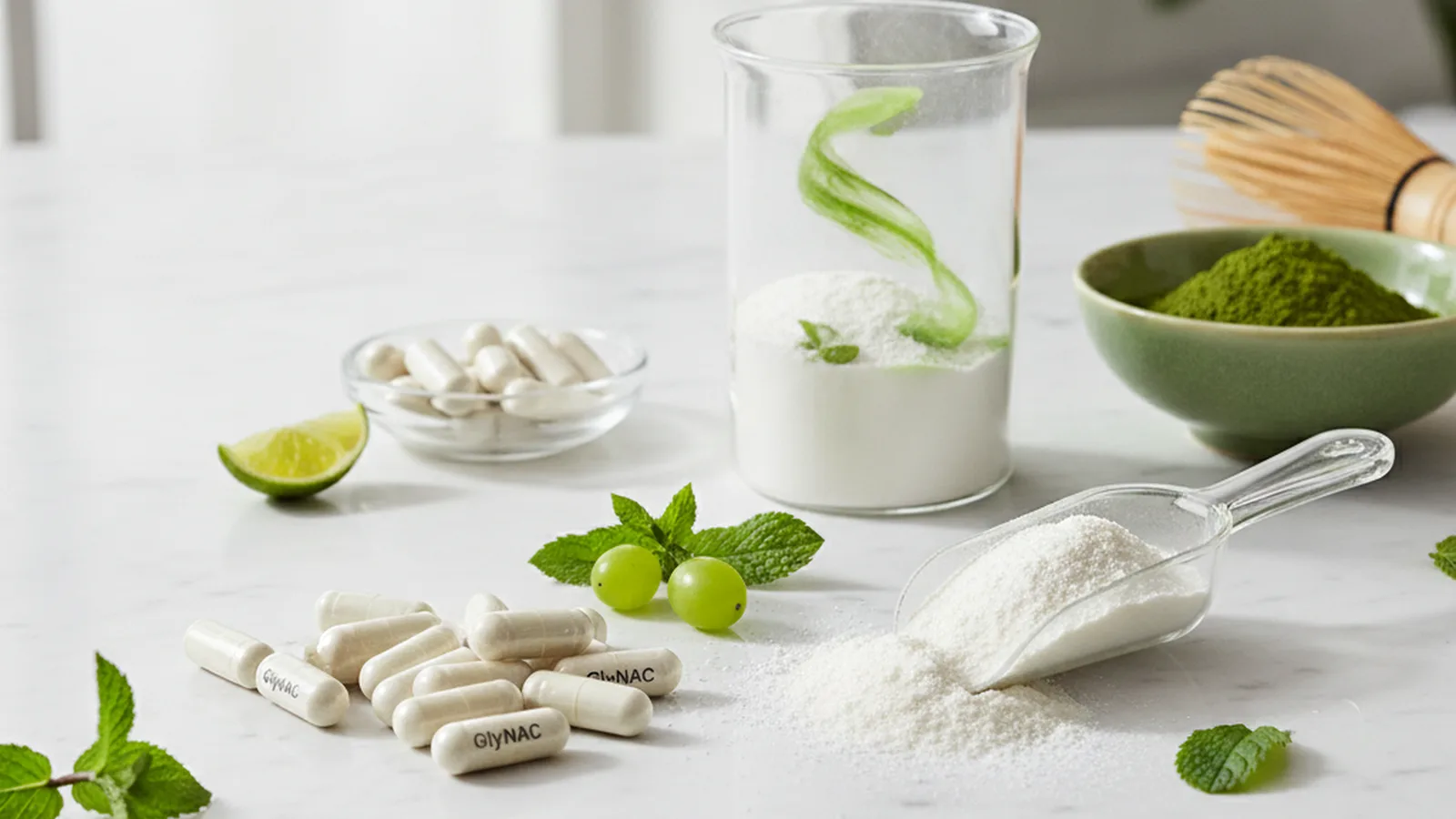
The longevity world loves an exotic molecule — a rare plant polyphenol, a synthesised drug, something that sounds like the future. So it is faintly subversive that one of the more intriguing recent ideas involves nothing more glamorous than two amino acids you could buy for pennies. The claim attached to them is anything but modest: that taken together, glycine and N-acetylcysteine can rebuild the body's depleted master antioxidant and reverse several measurable features of aging. That combination even has a nickname — GlyNAC. As always, the interesting work is separating the genuine signal from the hope.
Glutathione: the antioxidant your body builds itself
Most antioxidants people talk about — vitamin C, vitamin E, polyphenols — come from outside, in food or capsules. Glutathione is different: it is made inside your own cells, and it is the workhorse of the cell's defence against oxidative damage. Chemically it is a tripeptide (formula C10H17N3O6S) assembled from three amino acids — glutamate, cysteine and glycine — and it sits at high concentration in virtually every cell, neutralising reactive oxygen species, recycling other antioxidants and helping the liver detoxify. It is not a fringe nutrient; it is central plumbing.
Here is the part that ties it to aging. Oxidative stress — an imbalance between damaging reactive molecules and the defences that mop them up — is one of the recognised threads running through the biology of getting older, closely bound up with failing mitochondria. If the cell's principal antioxidant runs low as we age, that would be a plausible mechanistic contributor to the decline, not just a bystander. And the evidence that glutathione does run low with age is fairly solid.
Why glutathione falls with age — a supply problem
The key insight came from work at Baylor College of Medicine. Using stable-isotope tracing to measure not just how much glutathione older people had but how fast they made it, Sekhar and colleagues found that healthy elderly adults had markedly lower red-blood-cell glutathione than younger adults — and, crucially, a much slower rate of synthesis. The older group also had lower cellular concentrations of two of the building blocks: cysteine and, strikingly, glycine.[1] In other words, the shortage looked less like the antioxidant being destroyed faster and more like a supply-chain problem: the cells were short of raw materials and were building less.
That reframing matters, because a supply problem suggests an obvious experiment. If glutathione is low because the precursors are low, then giving back the precursors should let the machinery run again. In that same 2011 study, supplementing older adults with cysteine (as N-acetylcysteine) and glycine for two weeks restored glutathione synthesis and concentrations to youthful levels and lowered markers of oxidative stress.[1] That short proof-of-concept is the seed the whole GlyNAC story grew from.
The GlyNAC idea, spelled out
GlyNAC is deliberately unclever: it is just those two limiting building blocks combined. Glycine (C2H5NO2) is the simplest amino acid; N-acetylcysteine (C5H9NO3S) is a stable, well-absorbed delivery form of cysteine that has been used in medicine for decades, including as the antidote for paracetamol overdose. Supply both, the reasoning goes, and the cell can rebuild glutathione; restore glutathione, and you dial down oxidative stress; dial down oxidative stress, and the mitochondria — which are exquisitely sensitive to it — can work better. Better mitochondria, in turn, touch nearly everything the body does with energy.
It is a tidy chain of logic, and tidy logic is exactly the kind of thing that has misled longevity science before. The question is whether the chain holds up when you actually test it in people, on outcomes that matter rather than on a graph of glutathione alone.

What the human trials showed
The Baylor group ran two clinical trials that put the idea to the test. The first, published in 2021, was an open-label pilot in eight older adults who took GlyNAC for 24 weeks. The results were eye-catching: correction of glutathione deficiency, lower oxidative stress, improved mitochondrial fuel-oxidation, reduced inflammation and insulin resistance, less genomic damage, and better strength, gait speed and cognition — and, tellingly, several benefits faded after the supplement was withdrawn for 12 weeks.[2] That withdrawal effect is scientifically useful: things that reverse when you stop the intervention are more likely to be caused by it.
The more important study came in 2023: an actual randomized, placebo-controlled trial. Twenty-four older adults were assigned to either GlyNAC or an isonitrogenous alanine placebo for 16 weeks (a well-chosen placebo, since it matches the nitrogen load so the comparison isn't just "amino acids versus nothing"). Compared with placebo, GlyNAC corrected glutathione deficiency and improved oxidative stress, mitochondrial function, inflammation, endothelial function, insulin resistance, several molecular hallmarks of aging, gait speed, muscle strength, six-minute-walk distance, waist circumference and systolic blood pressure.[3] Taken at face value, that is one of the broader panels of improvement reported for any simple supplement in older humans.
Why to stay calibrated anyway
This is where honest reporting earns its keep, because the temptation with a result like that is to declare victory. Don't. The single most important caveat is size and source: the randomized trial had 24 participants and, like the pilot, came from one research group at one institution. Extraordinary claims need independent replication, and as of now GlyNAC's headline anti-aging findings have not been reproduced by other labs in large samples. A broad panel of improvements in two dozen people is a strong reason to run bigger trials, not a reason to consider the matter settled.
There are subtler cautions too. The trials measured biomarkers and physical-function tests — glutathione, oxidative-stress markers, strength, blood pressure — not lifespan or hard clinical outcomes like heart attacks or death. Improving a marker is encouraging but is not the same as living longer or better, a lesson the longevity field has learned repeatedly. And measuring many outcomes at once, in a small trial, raises the statistical odds that some improvements are chance. None of this makes GlyNAC a dud; it makes it an unusually promising hypothesis whose confirmation is still pending.
Is it safe, and what about dose?
On safety, the picture is reassuring as far as it goes. Both components have long track records: glycine is an ordinary dietary amino acid, and NAC has decades of clinical use with a good safety profile. The published trials, which used roughly 100 mg per kilogram of body weight per day of each, reported that GlyNAC was well tolerated over 16 to 24 weeks.[3] That is a fairly high dose — for an 80 kg adult it works out to several grams of each per day — and it is worth noting the impressive results came from that specific regimen, not from a token pinch of either.
Two practical wrinkles. First, NAC's regulatory status as a dietary supplement has been contested in some jurisdictions because it was originally developed as a drug, so availability varies. Second, NAC can interact with certain medications (including some nitrates and blood thinners), and high doses of either amino acid can cause digestive upset. This is firmly in "talk to a clinician first" territory, especially for anyone on prescription medicine or managing a chronic condition.
An honest verdict
GlyNAC is one of the more genuinely interesting stories in longevity precisely because it is so unglamorous. The underlying biology is sound — glutathione really does fall with age, and it really does fall partly because the raw materials run short. The intervention is cheap, mechanistically coherent, and the early human data are, frankly, better than the data behind many far more hyped compounds. That is not nothing.
But "better than many hyped compounds" is a low bar, and the honest position is restraint. Everything rests on small trials from a single group, without independent replication and without outcomes beyond biomarkers. If you find the idea compelling, GlyNAC is inexpensive and appears well tolerated at studied doses — a defensible experiment on yourself, not a proven therapy. Keep your expectations pinned to the modest, marker-level evidence rather than the reversal-of-aging headlines, and remember that the interventions with the deepest longevity data — strength training, sleep, not smoking, a sane diet — are still doing the real work.
Common questions
What is GlyNAC and how is it supposed to work?
GlyNAC is simply glycine and N-acetylcysteine (NAC) taken together — the two building blocks your cells use to make glutathione, the body's main intracellular antioxidant. Both glutathione levels and the rate of glutathione synthesis fall with age, and cellular glycine and cysteine run low, so the theory is that supplying both missing precursors lets cells rebuild glutathione, lower oxidative stress and improve mitochondrial function.[1]
Does GlyNAC actually reverse aging in people?
It is too early to say. In a 16-week randomized controlled trial of 24 older adults, GlyNAC corrected glutathione deficiency and improved oxidative stress, mitochondrial function, inflammation, insulin resistance, blood pressure, walking speed and muscle strength versus placebo.[3] Those results are striking, but the trials are small, come from a single lab, are not yet independently replicated, and measured markers rather than lifespan. Treat it as a promising hypothesis, not a proven therapy.
Is it safe to take glycine and NAC together?
Both are long-used, generally well-tolerated compounds, and the trials at roughly 100 mg/kg/day of each reported good tolerability over 16 to 24 weeks.[3] NAC has decades of clinical use, though its supplement status has been questioned by regulators, and high doses of either can cause digestive upset. NAC can interact with some medications, so anyone on prescription drugs or managing a condition should check with a clinician first.