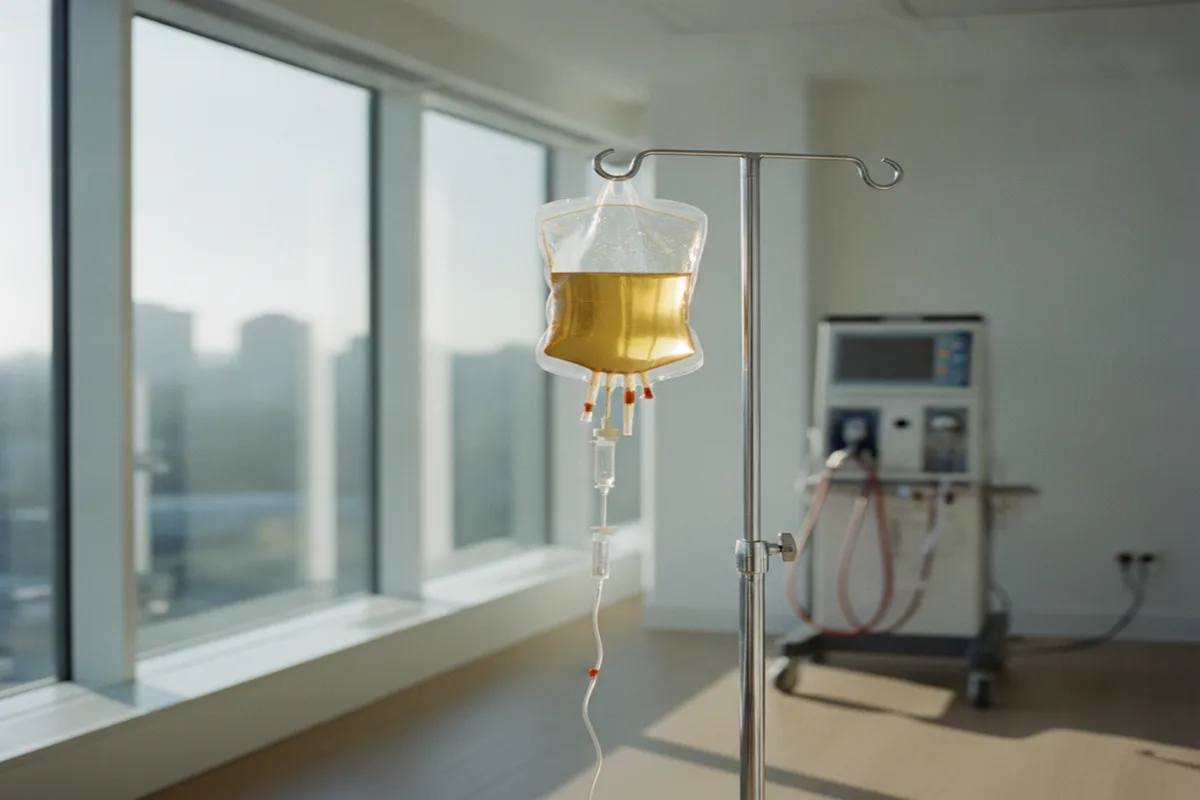
In 2023, the tech entrepreneur Bryan Johnson made global headlines for an experiment that sounded like science fiction dressed up as body horror: he had a liter of his 17-year-old son’s blood plasma transfused into his own veins, part of a self-funded quest to slow his aging. The “blood boy” framing was irresistible to the internet. Johnson later abandoned that particular stunt, saying it produced no measurable benefit, and pivoted to a different procedure: total plasma exchange, in which his own plasma was removed wholesale and swapped for a protein solution. The spectacle put a very old scientific idea back in the spotlight — the notion that something circulating in old blood helps drive aging, and that cleaning it out might turn back the clock. This is the honest version of where that idea actually stands.
What plasma exchange actually is
Blood is roughly half cells — red cells, white cells, platelets — and half plasma, the straw-colored fluid they float in. That plasma is not just water. It carries proteins, antibodies, hormones, clotting factors, cholesterol, inflammatory signaling molecules and a vast amount of cellular debris. Therapeutic plasma exchange, or TPE, uses a machine to spin your blood, siphon off the plasma, and return your blood cells to you suspended in a replacement fluid — usually a sterile solution of albumin, the body’s most abundant blood protein.[4]
This is not a fringe technology. TPE has been a standard hospital procedure for decades, used to treat serious autoimmune and neurological conditions such as myasthenia gravis, Guillain-Barré syndrome and certain antibody-driven diseases, where the goal is to physically strip harmful antibodies out of the blood. What is new is the attempt to repurpose that same machinery against aging itself, in people who are not sick at all.
The idea behind swapping old blood
The rationale traces back to a startling line of animal research. Decades ago, scientists surgically joined the circulatory systems of a young mouse and an old one — a technique called parabiosis — and found that the old mouse’s tissues partly rejuvenated while the young mouse’s aged faster. For years the assumption was that young blood contained magical restorative factors. But later work flipped the interpretation: a good deal of the benefit seemed to come not from adding youthful ingredients, but from diluting the accumulated bad ones in old blood.
That reframing matters, because dilution is something a plasma-exchange machine does very well. In a 2022 clinical study, researchers led by bioengineers at UC Berkeley reported that repeated rounds of TPE shifted the blood proteome of older adults toward a younger profile — restoring more youthful levels of pro-regenerative and anticancer regulators, and lowering markers of cellular senescence and DNA damage. They argued that human aging is driven in part by an “age-imposed systemic molecular excess,” and that periodically flushing it out could measurably lower biological age.[2] It was a provocative claim, built on a small sample, but it set the stage for a more rigorous test.
The 2025 trial that made headlines
That test arrived in 2025, when a team at the Buck Institute for Research on Aging published a randomized, placebo-controlled trial — the gold standard — in the journal Aging Cell. Forty-two healthy adults over 50 were assigned to one of several regimens: biweekly TPE, biweekly TPE combined with intravenous immunoglobulin (IVIG, an immune-supporting infusion), monthly TPE, or a placebo. The researchers then profiled an unusually deep panel of biology — the epigenome, proteome, metabolome, immune cytokines and more — before and after.[1]
The results were the reason the story traveled. Compared with placebo, TPE significantly improved measures of biological age, with 15 separate epigenetic clocks showing rejuvenation. The standout regimen was the biweekly TPE-plus-IVIG combination, which produced what the authors described as coordinated cellular and molecular responses: it appeared to reverse aspects of age-related immune decline and to quiet proteins tied to chronic inflammation — the smoldering, low-grade inflammation researchers call “inflammaging.” Intriguingly, an integrated analysis suggested the people who benefited most were those who started in poorer health, hinting that TPE might do more for a struggling system than for an already-robust one.[1]
This is a genuinely important result, and it deserves to be taken seriously. It is the first multi-omics, placebo-controlled study to show that different plasma-exchange protocols can move a whole battery of aging clocks in the right direction. If you were building a case that TPE deserves real scientific attention rather than eye-rolling, this is your exhibit A.
The study that complicates the picture
Here is where careful reading separates from hype. Also in 2025, a Czech research group ran their own randomized trial of plasmapheresis in healthy adults — and got a very different answer. Crucially, their protocol was a stripped-down version: they removed plasma without replacing the volume with young plasma or albumin. Across an 18-week course, they found no meaningful epigenetic rejuvenation. Worse, by several clock measures — including GrimAge and the Dunedin pace-of-aging estimate — the procedure appeared to nudge biological aging in the wrong direction, alongside changes such as falling cholesterol and shifting mineral levels. Their sober conclusion: this particular protocol did not deliver benefits and may accelerate epigenetic aging, and more long-term safety research is needed.[3]
The two trials are not really contradictory once you look closely — they are a lesson in how much the details matter. The Buck study replaced the discarded plasma with albumin (and often added IVIG); the Czech study did not replace it at all. That single design difference may be the whole ballgame. It suggests that if TPE helps, it is not simply the act of removing plasma that matters, but what you put back and how the immune system is supported afterward. It also means that any clinic offering a bare-bones “detox” version of the procedure could, on current evidence, be doing nothing useful at best. The honest headline is not “plasma exchange reverses aging” but “a specific plasma-exchange protocol moved aging biomarkers in one rigorous trial, while a different protocol did the opposite.”
Biomarkers are not the same as living longer
There is a deeper caveat that applies even to the encouraging trial. Every one of these studies measured biological-age biomarkers — epigenetic clocks, protein signatures, immune profiles — not actual health outcomes. Nobody has yet shown that people who undergo TPE go on to live longer, get sick less often, or stay physically and mentally sharper than people who don’t. Epigenetic clocks are powerful research tools, but they are still proxies, and the longevity field has been burned before by interventions that shifted a biomarker without changing anyone’s life. Moving a clock is a promising signal that justifies bigger, longer trials — it is not proof that the underlying aging process has truly been slowed.
Is it safe, and what does it cost?
On safety, the reassuring news is that TPE is a mature procedure with a well-characterized risk profile. In the Buck trial it was generally well tolerated, with only two participants stopping early for adverse events. A 2025 review of TPE’s expanding applications describes it as broadly safe when done properly, while emphasizing it remains an invasive medical procedure.[4] That word — invasive — is the point. TPE requires large-bore intravenous access and moves significant fluid volumes, and it can cause allergic reactions, drops in blood pressure, low calcium, bleeding or clotting issues and, rarely, infection. This is emphatically not a spa treatment, and it has no business being done outside a proper clinical setting.
Cost is the other reality check. Because there is no approved anti-aging indication, any longevity use is strictly off-label and paid out of pocket. Private clinics commonly charge from around one to several thousand dollars per session, and the protocols that showed benefit used repeated sessions over months — so a meaningful course can climb into five figures. Set that against the fact that no one has demonstrated a durable health benefit, and the math for a healthy person looks decidedly speculative.
An honest verdict
Plasma exchange sits at a fascinating and genuinely uncertain frontier. The underlying biology — that aging is partly driven by an accumulating burden in the blood, and that removing it might help — is real, decades deep, and newly supported by a rigorous multi-omics trial. That is more than most viral longevity trends can claim. But the same year produced a well-designed study pointing the opposite way, the benefits so far are measured only in biomarkers rather than lived health, the procedure is invasive and expensive, and the difference between a protocol that helps and one that might hurt appears to come down to technical details we don’t yet fully understand.
So where does that leave a sensible person? Watching closely, not booking an appointment. Plasma exchange is one of the more scientifically credible ideas in the rejuvenation space — credible enough to deserve the large, long-term outcome trials now needed to settle it — but it is nowhere near ready to be recommended as an anti-aging treatment for healthy people. If you have a spare five figures and an appetite for the frontier, the responsible way to spend it is on a registered clinical trial, not a clinic’s off-label package. And it is worth remembering, as always, that the interventions with the deepest longevity evidence — regular exercise, sleep and not smoking — are still quietly outperforming almost everything that comes in an IV bag.
Common questions
Does plasma exchange actually reverse aging?
The evidence is early and mixed. A 2025 randomized trial from the Buck Institute found that therapeutic plasma exchange, especially combined with intravenous immunoglobulin, rejuvenated 15 epigenetic aging clocks compared with placebo in adults over 50. But a separate 2025 trial of plasmapheresis without albumin or plasma replacement found no rejuvenation and even signs of faster epigenetic aging. No study has yet shown that plasma exchange makes people live longer or healthier over the long term, so it is best described as a promising but unproven experimental approach.
Is therapeutic plasma exchange safe?
Therapeutic plasma exchange is an established medical procedure used for decades to treat certain autoimmune and neurological diseases, and in the 2025 aging trial it was generally well tolerated, with only two of the participants stopping early for adverse events. That said, it is an invasive procedure involving large-bore IV access and fluid shifts, and it carries real risks including allergic reactions, low blood pressure, low calcium and, rarely, infection. It should only ever be done in a proper clinical setting under medical supervision.
How much does a plasma exchange for anti-aging cost?
There is no approved anti-aging indication, so any longevity use is off-label and paid out of pocket. Private clinics typically charge from around one to several thousand dollars per session, and the trial protocols that showed benefit used repeated sessions over months, so a full course can run into five figures. Given the unproven long-term benefit, most experts consider it far too early to spend that kind of money outside a clinical trial.