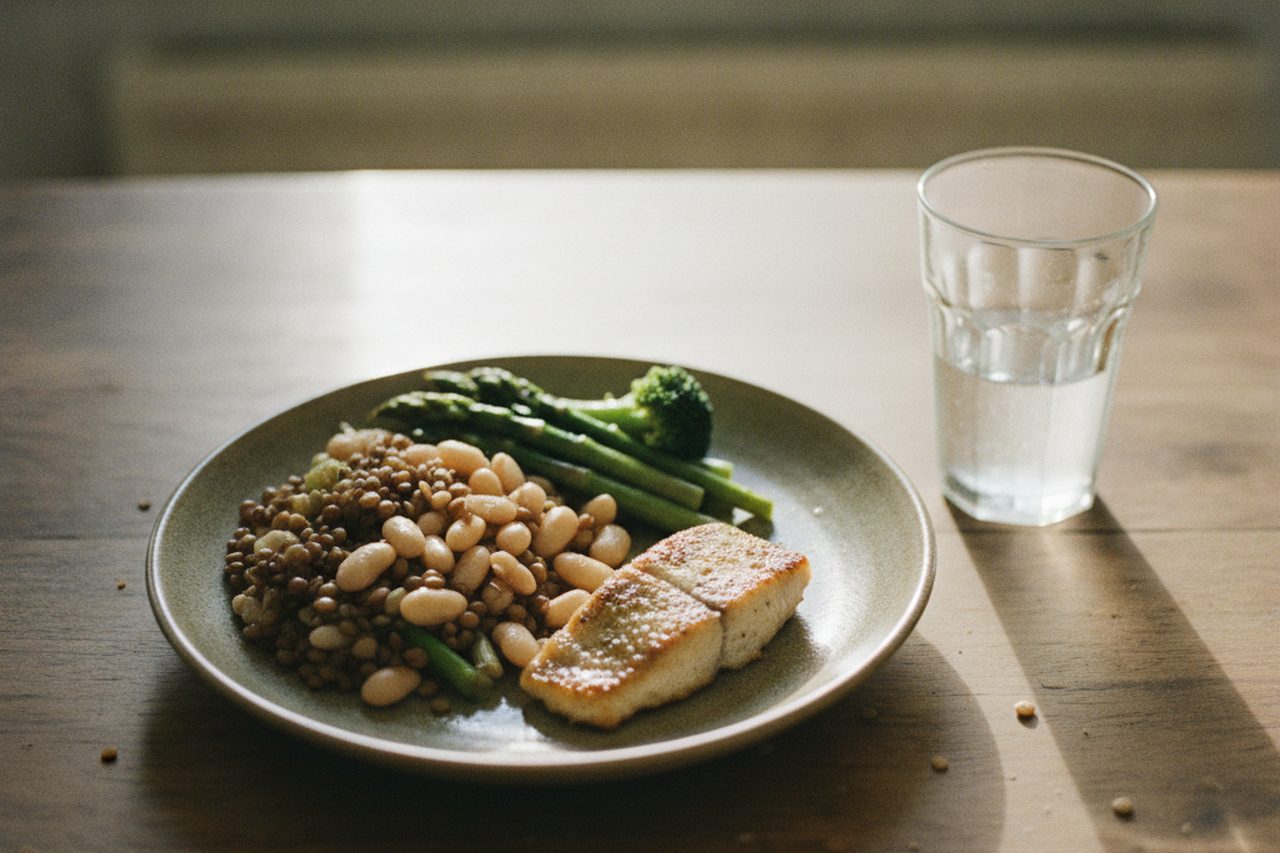
Walk into any supermarket and count the protein claims. High-protein yoghurt, high-protein bread, high-protein water. Over the past three years, protein went from a nutrient to an identity, and “are you getting enough protein?” became the single most reliable engagement bait in wellness media.
So it landed awkwardly when, on 31 July 2026, a research team at the University of Wisconsin–Madison published a synthesis of more than 350 studies in the Cell Press journal Blue arguing that for a large share of adults, the problem may be the opposite one.[1] The paper, by Bailey Knopf and Dudley Lamming, catalogues what happens to a body when protein and specific amino acids are pulled back: better insulin sensitivity, lower inflammation, reduced cellular damage, and in animals, a longer life.
Headlines converted this into “eating less protein slows aging.” That is not quite what the paper says, and the gap between the two is where all the useful information lives.
Protein is a signal, not just a building material
Most people think of dietary protein the way you think of bricks: raw material for muscle, skin, enzymes. It is that. But it is also a message.
Amino acids from your food are constantly read by a molecular sensor called mTOR, which acts as the cell’s growth switch. Abundant protein tells mTOR that conditions are good — build, divide, grow. Scarce protein flips the cell into a maintenance mode: repair damage, recycle worn-out components, hold position. Nearly every intervention that reliably extends lifespan in animals, from calorie restriction to rapamycin, converges on turning that switch down.
The clearest demonstration that this is about signalling rather than calories came from a 2014 mouse study at the University of Sydney. Researchers fed 858 mice one of 25 different diets, systematically varying protein, fat and carbohydrate. Lifespan and cardiometabolic health were optimised on diets that were low in protein and high in carbohydrate — and restricting calories using a high-protein diet produced no lifespan benefit at all.[2] The ratio mattered. The calorie count, on its own, did not.
The hormone at the centre of it
The mechanism that has emerged since then, and that anchors the new review, is a liver hormone called FGF21 — fibroblast growth factor 21. When protein intake drops, FGF21 rises. It increases energy expenditure, improves glucose control and reduces inflammation, and mice engineered to overproduce it live longer.
What makes FGF21 genuinely interesting is that it does not respond to protein as a bulk quantity. It responds to specific amino acids. In 2022, Lamming’s group laid out the case that most of the benefit of a low-protein diet is really the effect of eating fewer branched-chain amino acids — leucine, isoleucine and valine.[3]
Then they tested it properly. In a 2023 experiment published in Cell Metabolism, genetically heterogeneous mice were fed diets with isoleucine reduced by roughly two-thirds, starting in adulthood. The animals became leaner and more glucose-tolerant, showed less frailty, and lived measurably longer — the effect was larger in males than females.[4] One amino acid, cut in isolation, moved lifespan.
That is a striking result. It also happens to describe the exact amino acids concentrated in whey protein powder, the substance the wellness internet has spent three years recommending.
What we actually know about humans
Here the story gets thinner, and honest coverage has to say so. No randomised trial has ever tested whether eating less protein makes a person live longer. Such a trial would need to run for decades, and nobody is funding it.
What exists is one influential observational analysis and a handful of short metabolic studies. The 2014 analysis, led by Morgan Levine and Valter Longo, followed a nationally representative US sample and reported that adults aged 50 to 65 with high protein intake had a 75 percent higher risk of death from any cause and a four-fold higher risk of cancer death over the following 18 years.[5]
Two details from that paper rarely survive the retelling. First, the association was largely abolished when the protein came from plants rather than animals. Second — and this is the one that matters most — the pattern reversed after 65. In the over-65 group, higher protein intake was associated with lower overall and cancer mortality. The authors’ own conclusion was not “eat less protein.” It was that low protein in middle age followed by moderate-to-high protein in old age may be optimal.
Short-term human work is more encouraging but far more modest in scope. A 2024 randomised trial in Australia put 113 adults aged 65 to 75 on whole-food diets at a moderate 14 percent protein for four weeks. FGF21 rose across the whole sample, and the more plant-based arm showed lower diastolic blood pressure, total cholesterol and glucose.[6] Four weeks of biomarkers is not lifespan, but it shows the mechanism is live in humans, not just mice.
Why this does not contradict the “more protein” advice
The apparent war between these two camps is mostly a failure to specify the population. Both can be right, because they are describing different people.
The case for more protein is about muscle, and it is solid. From the fifth decade onward, muscle becomes progressively less responsive to the protein you eat — a phenomenon called anabolic resistance, which we cover in detail in our guide to protein after 40. The PROT-AGE expert group, convened by the European Union Geriatric Medicine Society, recommends at least 1.0 to 1.2 g of protein per kilogram of body weight daily for people over 65, and 1.2 g/kg or more for those who are physically active.[7] Losing muscle mass in your seventies predicts falls, loss of independence and death far more concretely than any biomarker of cellular aging.
The case for less protein is about metabolic signalling, and it applies most clearly to sedentary adults in midlife with insulin resistance or excess weight. Notably, the review’s authors observe that physical activity appears to blunt the downside of high protein intake, plausibly because training routes those amino acids into muscle rather than into chronic growth signalling.
There is also a ceiling worth knowing. A meta-analysis of 49 resistance-training trials with 1,863 participants found that protein intake beyond roughly 1.62 g/kg per day produced no further gain in fat-free mass.[8] Above that line you are not building more muscle. You are only sending a stronger growth signal — which is precisely the thing the longevity researchers are worried about.
What a reasonable person does with this
The single most defensible reading of the current evidence is that protein needs are not one number, and the honest framing is a decision tree rather than a headline.
If you are under about 65, sedentary, and carrying metabolic risk, the research suggests you are unlikely to benefit from stacking protein shakes onto an already protein-heavy diet — and shifting part of your protein from animal to plant sources is the change with the best evidence behind it, since that shift also reduces branched-chain amino acid load without any counting. If you are over 65, or you train seriously, the muscle argument dominates, and deliberately cutting protein risks the one thing that most reliably determines how the last decade of your life goes. Our piece on muscle loss and exercise covers why training is the non-negotiable half of that equation.
It is also worth noticing what the mouse data really tested. Those animals ate low-protein diets for life, from a young age, with everything else controlled — a scenario nobody replicates. And there is a plausible middle path that sidesteps the whole argument: periodic rather than permanent restriction. That is part of why fasting research and fasting-mimicking protocols keep showing up in the same conversation, though the human lifespan evidence there is no stronger.
What we would avoid is the reflex the wellness internet reaches for every time a study like this lands: turning it into a new number to maximise. The fibermaxxing trend ran the same playbook with fibre, and the same trap applies here in reverse. The finding is not “protein is bad.” It is that a nutrient can be a signal as well as a substrate, and that the right dose depends on which of those two jobs your body most needs it to do right now.
Common questions
Does eating less protein really slow aging?
In animals, the evidence is strong: mice fed low-protein diets live longer and stay metabolically healthier, and restricting the single amino acid isoleucine extended lifespan in genetically diverse mice. In humans, the evidence is indirect. The largest observational analysis found that adults aged 50 to 65 with high protein intake had a 75 percent higher risk of death from any cause over the following 18 years, but the same pattern reversed after age 65. No randomised trial has ever tested whether eating less protein makes people live longer, because such a trial would take decades.
What is FGF21 and why does it matter for protein intake?
FGF21 is a hormone released mainly by the liver when dietary protein or specific amino acids run low. It raises energy expenditure, improves blood sugar control and dampens inflammation, and mice genetically engineered to produce more of it live longer. It appears to be one of the main signals through which a lower-protein diet produces metabolic benefits, which is why researchers describe protein restriction as a signal the body responds to rather than simply a shortage of building material.
How much protein should I eat after 50?
There is no single answer, and that is the actual finding. The PROT-AGE expert group recommends at least 1.0 to 1.2 g of protein per kilogram of body weight per day for people over 65, and 1.2 g/kg or more for those who exercise. Meta-analysis of resistance-training trials found no additional muscle gain above roughly 1.6 g/kg per day. The protein-restriction research applies mostly to sedentary, metabolically unhealthy adults in midlife, not to older adults losing muscle. Anyone with kidney disease should follow their clinician’s advice rather than any general guideline.